雌
Character Story & Explanation
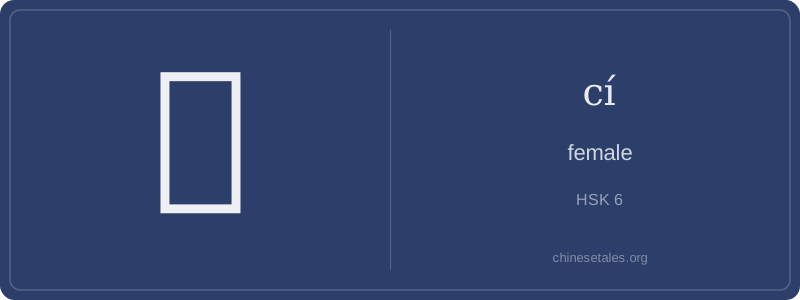
The earliest form of 雌 appears in bronze inscriptions as a composite: the left side was a variant of 兹 (zī), an ancient phonetic element meaning 'this' or 'here', and the right side was 隹 (zhuī), a pictograph of a short-tailed bird—originally depicting head, wings, and feet in simplified strokes. Over centuries, 兹 evolved into the top-left component (with its two vertical strokes and crossbar), while 隹 remained visually stable on the right, anchoring the character’s zoological essence. The modern 14-stroke form crystallized in the Han dynasty, balancing phonetic clarity and semantic immediacy.
By the Warring States period, 雌 had already specialized beyond birds to mean 'female' across species—a shift recorded in texts like the *Zhuangzi*, where 雌雄 (cí-xióng) describes complementary cosmic forces, echoing yin-yang duality. Its visual pairing with 雄 (which features 攵, 'to strike', suggesting active force) reinforces an ancient worldview: gender as dynamic, observable, and interdependent—not hierarchical, but ecological. The bird radical 隹 isn’t decorative; it’s a reminder that this concept took flight from the natural world, not philosophy.
At its core, 雌 (cí) isn’t just a neutral label like 'female' in English—it carries a subtle biological, often zoological, precision. You’ll rarely hear it used for human women (that’s 女 or 女性); instead, it’s the go-to term for female animals (雌 lion, 雌 eagle), plants (雌 flower), or even abstract entities like electric currents (雌 port = female connector). It feels clinical, scientific, and quietly authoritative—like a field biologist noting gender in a logbook.
Grammatically, 雌 is almost always an attributive adjective, directly preceding a noun with no particle: 雌鸟 (cí niǎo, 'female bird'), not *雌的鸟. It pairs tightly with its counterpart 雄 (xióng, 'male') to form binary pairs—think 雌雄同体 (cí-xióng tóng-tǐ, 'hermaphrodite') or 雌雄莫辨 (cí-xióng mò biàn, 'indistinguishable as male or female'). Learners sometimes mistakenly insert 的 or use it pronominally ('she'), but 雌 never stands alone as a pronoun—it’s always part of a compound.
Culturally, this character reflects ancient Chinese observation of nature: gender wasn’t abstracted into social roles first, but grounded in observable biological traits—feathers, behavior, reproductive structures. A common error? Confusing 雌 with 慈 (cí, 'kind')—same sound, totally different world. While 雌 observes, 慈 embraces. And crucially: calling a person 雌 is deeply inappropriate—like labeling someone 'ovulating specimen' in English. Respect lives in the right word.