露
Character Story & Explanation
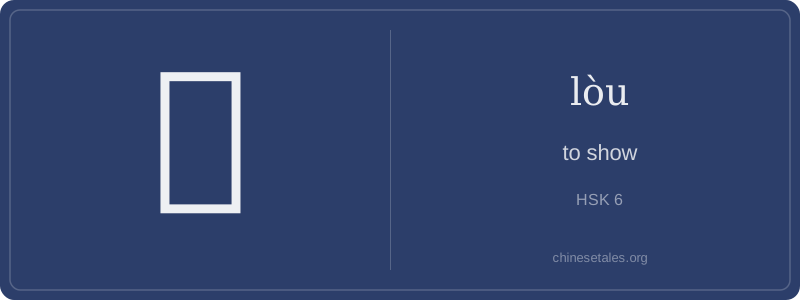
Oracle bone inscriptions don’t preserve 露, but its earliest form in bronze script (c. 1000 BCE) already combined 雨 (a canopy of raindrops) atop 路 (lù, 'road' or 'path', later simplified to 各). The original idea wasn’t meteorology — it was *appearance on the path*: rain falling onto a road makes surfaces glisten, revealing wetness; later, the character came to symbolize anything that *comes into view along a visible route*. Over centuries, the lower component morphed from 路 to 洛 and finally to the modern 雔-like structure beneath 雨 — a stylized 'foot stepping onto ground', reinforcing the idea of emergence into visibility.
By the Warring States period, 露 appeared in texts like the *Zuo Zhuan* describing how 'the true nature of a ruler 露于言表' — revealed in speech and expression. Its dual pronunciations crystallized early: lù for the physical phenomenon (dew, dewfall), lòu for the act of emerging or betraying — a semantic split mirroring Chinese philosophy’s emphasis on *manifestation* (lòu) versus *natural occurrence* (lù). The 21-stroke complexity reflects its layered meaning: rain + emergence + human presence = something both delicate and consequential.
At its core, 露 (lòu) is about *unintended emergence* — not just 'to show' but to *betray*, *leak*, or *give away* something hidden: a flaw, a feeling, or a secret. Think of steam rising from hot tea, a blush spreading across cheeks, or a lie slipping out — it’s involuntary, often revealing what was meant to stay concealed. This nuance is crucial: you wouldn’t use 露 for deliberate display (that’s 展示 or 显示); instead, it carries quiet tension, like the moment a mask slips.
Grammatically, lòu is almost always a verb in *resultative or aspectual constructions*, often paired with directional complements or aspect particles. You’ll see it as 露出 (lù chū — 'to reveal outward'), 露面 (lù miàn — 'to appear [in public]'), or in the common pattern 露了马脚 (lòu le mǎ jiǎo — 'showed one’s hoof', i.e., gave oneself away). Note the tone shift: lòu only appears in this 'showing' sense; lù (as in 露水 lùshuǐ, 'dew') belongs to the noun/adjective realm and never functions as a verb meaning 'to show' — mixing these tones is a top-5 HSK 6 error.
Culturally, 露 taps into China’s deep-rooted value of restraint and face (miànzi). To 露丑 (lòu chǒu, 'expose one’s ugliness') or 露馅儿 (lòu xiànr — 'leak the filling', i.e., blow your cover) isn’t just awkward — it’s socially destabilizing. Learners often overuse it like English 'show', missing its connotation of vulnerability or unintended exposure. Also: watch the radical! 雨 (rain) hints at moisture and impermanence — what appears (like dew) may vanish just as quickly.