饥
Character Story & Explanation
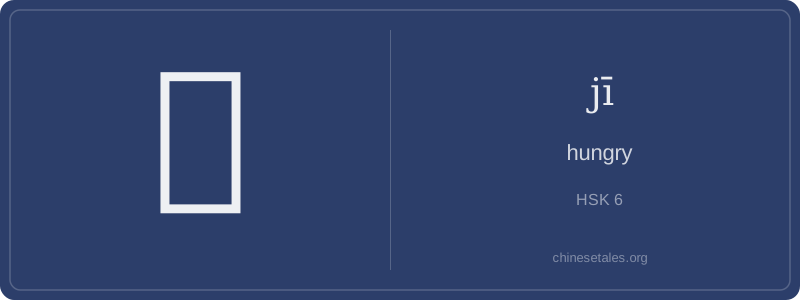
The earliest form of 饥 appears in bronze inscriptions (c. 1000 BCE) as a combination of 米 (mǐ, ‘rice’) and 几 (jī, an ancient pictograph of a low table or stand), suggesting ‘grain placed on a table’ — but wait! Over centuries, 米 simplified and fused with the food radical 饣 (shí, ‘food’), while 几 morphed into the right-hand component, now written as 几 — same shape, different origin story. Crucially, the original 几 here wasn’t the numeral ‘several’ but a phonetic loan: it provided the *jī* sound and subtly reinforced the idea of ‘lack’ — because 几, in early usage, also carried connotations of ‘barely’ or ‘scarcely’. So visually, 饥 whispers: ‘food — barely there’.
This duality — sound + scarcity — anchored its meaning from the start. In Confucian classics like the *Mencius*, 饥 appears alongside 寒 (hán, ‘cold’) to denote the two primal human sufferings: ‘When people are hungry and cold, they have no moral restraint’ (《孟子》: ‘饥寒交迫’). By the Tang dynasty, poets used 饥 metaphorically — Li Bai wrote of ‘hunger for immortality’ (饥仙), stretching the word beyond the stomach into spiritual yearning. Even today, its five-stroke simplicity belies a profound semantic depth: every stroke points not to appetite, but to absence.
At its heart, 饥 (jī) isn’t just ‘hungry’ — it’s the visceral, urgent hunger that gnaws when food is scarce, not the mild ‘I could eat something’ feeling. That’s why it rarely appears alone in modern speech: you’ll almost never hear someone say *‘Wǒ jī.’* Instead, it lives in compounds like 饥饿 (jī’è, ‘starvation’) or adjectival phrases like 饥肠辘辘 (jī cháng lù lù, ‘stomach rumbling loudly’). It carries weight — emotional, historical, even moral — so using it casually (e.g., joking about being ‘hungry’ for snacks) can sound oddly dramatic or even bleak to native ears.
Grammatically, 饥 functions mainly as a bound morpheme: it needs company. You’ll see it as the first character in nouns (饥荒 jīhuāng, ‘famine’), verbs (饥饿 jī’è, ‘to starve’), and fixed idioms — but almost never as a standalone predicate adjective like 好 (hǎo) or 大 (dà). A classic learner mistake? Substituting 饥 for 饿 (è) in everyday contexts. While both mean ‘hungry’, 饿 is neutral and conversational (‘I’m hungry’ = 我饿了 wǒ è le); 饥 is literary, intensified, or systemic — think drought-induced famine, not lunchtime impatience.
Culturally, 饥 evokes collective memory: ancient texts like the *Book of Documents* (《尚书》) use it to describe calamity and failed governance — hunger wasn’t personal; it was political. That’s why modern media still reaches for 饥 when framing crises: 饥民 (jīmín, ‘starving people’) implies structural injustice, not individual appetite. Learners who treat it like a synonym for ‘hungry’ miss this gravity — and risk sounding unintentionally apocalyptic over a skipped breakfast.