馅
Character Story & Explanation
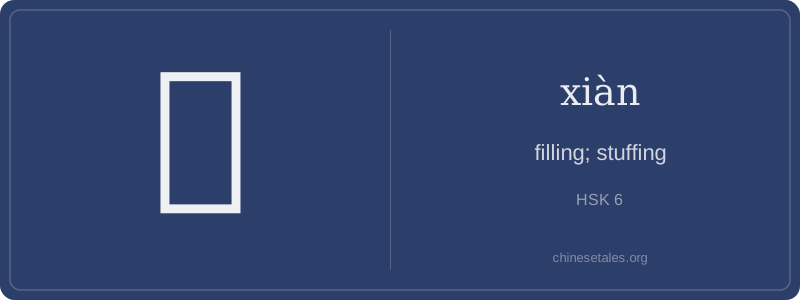
Trace 馅 back to its earliest forms, and you’ll find no oracle bone script — it’s a latecomer, first appearing in seal script around the Qin-Han era. Its left side, 饣 (shí), is the abbreviated ‘food’ radical — a stylized cooking vessel with steam rising. The right side, 陷 (xiàn), originally depicted a person falling into a pit (阝 = mound/terrain, 阜 radical; 阜 + 阜 + 阜 + 阜 → simplified to 井 + 阜 in early forms), symbolizing ‘sinking in’ or ‘being concealed’. So visually, 馅 merges ‘food’ + ‘concealed/sunken’ — literally ‘the part sunk inside the food’, i.e., what’s hidden within the wrapper.
This visual logic became semantic reality by the Tang dynasty, when steamed buns and dumplings surged in popularity among urban elites and Buddhist monasteries. The character 馅 appears in Song dynasty texts like Meng Yuanlao’s *Dongjing Meng Hua Lu* (1147), describing street vendors selling ‘meat-stuffed mantou’ — their 馅 was prized for tenderness and seasoning. Crucially, the ‘hidden’ sense bled into metaphor: by Ming-Qing times, 露馅 (lù xiàn, ‘expose the filling’) meant revealing a lie or flaw — just as a torn dumpling skin reveals its contents, so does a slip of the tongue betray deception. The shape still whispers: what’s inside matters — and might just spill out.
At its heart, 馅 (xiàn) isn’t just ‘filling’ — it’s the delicious secret inside food that transforms a plain wrapper into something meaningful and satisfying. In Chinese culinary culture, the filling is where flavor, intention, and even identity reside: a dumpling’s 馅 reveals regional roots (spicy Sichuan pork vs. sweet Beijing jujube), family tradition, or festive symbolism (gold-coin-shaped lotus seed paste for prosperity). Linguistically, 馅 is almost always a noun — you don’t ‘fill’ with it; you *have* it, *choose* it, or *taste* it. You say 这个包子馅儿很香 (zhè ge bāozi xiànr hěn xiāng), not *‘xiàn le’* — unlike English, Chinese doesn’t verb this concept.
Grammatically, it’s famously paired with the diminutive 儿 (ér) in northern Mandarin: 馅儿 (xiànr), softening the word and adding warmth — think of how ‘dumpling’ sounds friendlier than ‘stuffed dough’. Learners often mistakenly use 馅 as a verb (e.g., *wǒ xiàn le tā*), but no — that’s the verb 馅 (xiàn) only appears in rare, archaic literary contexts meaning ‘to expose weakness’ (as in 露馅 — lù xiàn, ‘to give away a secret’). That dual meaning — edible core and hidden flaw — is key!
Culturally, 馅 carries subtle social weight: offering someone your best 馅 shows care; a poorly made 馅 implies neglect. And beware the trap of overgeneralizing: 馅 never means ‘content’ in abstract senses (like ‘content of a speech’) — that’s 内容 (nèiróng). Also, while English says ‘chocolate filling’, Chinese prefers 巧克力馅 (qiǎokèlì xiàn) — no measure word needed, because 馅 functions like an uncountable mass noun, like ‘rice’ or ‘sugar’.