骚
Character Story & Explanation
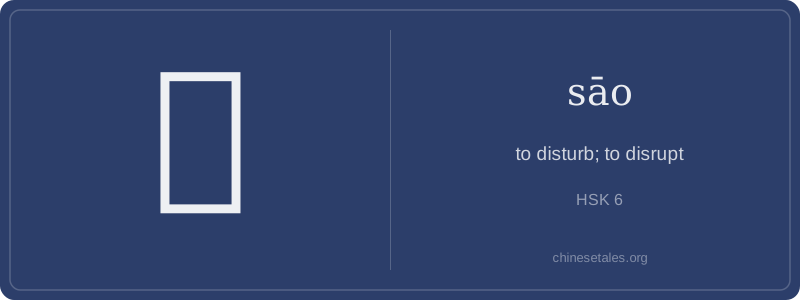
The earliest form of 骚 appears in bronze inscriptions as a combination of 馬 (horse) on the left and 扏 (a variant of 尧, yáo, meaning 'lofty' or 'eminent') on the right — not a picture of a horse kicking, but a symbolic fusion: a noble steed whose restless energy disrupts stillness. Over centuries, 扏 simplified into 爻 (yáo, 'divinatory lines'), then further eroded into the modern 又 + 勹 + 丶 structure atop the horse radical. Crucially, the 12 strokes encode motion (the twisting 又), containment (the wrapping 勹), and a final disruptive dot (丶) — like a spark igniting chaos beneath calm hooves.
This visual tension mirrors its semantic journey: in the Chu Ci (Songs of Chu), Qu Yuan titled his masterpiece Lisao — literally 'Encountering Sorrow', but 'sāo' here implied inner agitation, political unrest, and poetic rebellion against corruption. By the Tang dynasty, it acquired connotations of flamboyant, even provocative, self-expression. Today, that ancient 'noble horse in turmoil' lives on in phrases like 骚包 (flashy show-off) — proving that 2,300 years ago, poets already knew: true disruption begins not with force, but with style.
Think of 骚 (sāo) as the Chinese equivalent of 'to ruffle feathers' — not just physical disturbance, but a low-grade, persistent irritation that unsettles harmony. It’s less like smashing a window (that’s 毁 huǐ) and more like tapping someone’s shoulder *just* as they’re about to fall asleep — annoyingly precise, socially awkward, and hard to ignore. In classical usage, it carried poetic weight (think Qu Yuan’s Lisao, 'Encountering Sorrow'), where 'sāo' evoked emotional turbulence; today, it’s mostly colloquial and slightly edgy — often implying unwanted attention or bureaucratic hassle.
Grammatically, 骚 is almost always transitive and appears in compound verbs: 骚扰 (sāo rǎo, 'to harass'), 骚动 (sāo dòng, 'disturbance/riot'), or the vividly idiomatic 骚包 (sāo bāo, 'show-offy, flashy'). You’ll rarely see it alone — unlike English 'disturb', you wouldn’t say 'I sāo him'; you’d say 'I sāo-rǎo him'. Also, avoid using it in formal writing unless quoting literature — it’s too informal and faintly provocative for official documents.
Culturally, learners often misread its tone: though written with the horse radical (马), it has zero to do with equines! And yes — it’s the same character used in the internet slang 骚操作 (sāo cāo zuò, 'a flashy, unorthodox move'), which sounds cheeky but isn’t vulgar. The biggest trap? Confusing it with 扰 (rǎo, 'to disturb') — they’re near-synonyms, but 骚 adds a layer of social impropriety, like an unwelcome flirtation or a noisy neighbor at 2 a.m.