驱
Character Story & Explanation
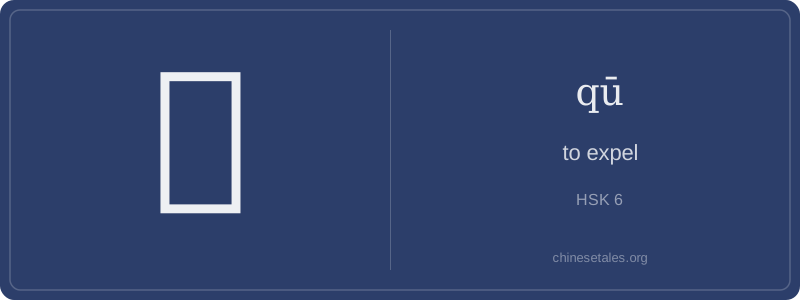
The earliest form of 驱 appears in bronze inscriptions as a combination of 馬 (horse) on the left and 尸 (a stylized figure, later evolving into 区) on the right — but crucially, the original right-hand component wasn’t 区; it was 曲, meaning ‘bent’ or ‘curved’, representing a whip or a coiled rope used to control horses. Over centuries, 曲 simplified and merged visually with the enclosing stroke, eventually becoming the modern 区 (qū, ‘area’), which now looks unrelated but phonetically anchors the character. The left-side 马 remains unmistakable: this was literally ‘to drive a horse’ — the foundational image of controlled, purposeful motion.
From ‘driving horses’ in Shang and Zhou chariot warfare, 驱 quickly extended metaphorically: to drive troops (《左传》: ‘驱而远之’ — ‘drive them far away’), to drive away evil (Han dynasty medical texts prescribe herbs to 驱风 — ‘drive off wind-disease’), and by Tang poetry, even abstract forces like sorrow (‘驱愁’ — ‘drive away sorrow’). Its visual logic held firm: the horse radical signals motion and agency; the right side (now 区) preserves the ancient sound and hints at containment — what’s driven is being pushed *out of a defined space*, reinforcing its core semantic of expulsion-from-a-boundary.
At its core, 驱 (qū) isn’t just ‘to expel’ — it’s about *forceful, directed removal*, like a shepherd driving sheep or a general commanding troops. It carries an air of authority and motion: the action is intentional, often urgent, and almost always involves agency — someone *makes* something leave. You’ll rarely see it for gentle or passive departure (that’s 离开 or 走); instead, it’s used when force, will, or external pressure pushes something out:驱虫 (drive away insects), 驱寒 (ward off cold), 驱逐出境 (expel from the country). Notice how the object is usually *unwilling* or *undesirable* — this character doesn’t eject friends; it ejects threats.
Grammatically, 驱 is almost always transitive and verb-initial in formal or literary contexts. It rarely stands alone — you’ll see it in compound verbs (驱散, 驱使) or with directional complements (驱走, 驱出). Learners often mistakenly use it where 排除 (eliminate) or 消除 (remove) would be more natural — e.g., saying *驱除错误* instead of the standard *消除错误*. Also, don’t confuse it with the homophone 去 (qù): 驱 implies active expulsion, while 去 is neutral departure.
Culturally, 驱 reflects a deep-rooted Chinese emphasis on maintaining order by removing disruption — whether literal pests, physical cold, ideological impurity, or political dissent. In classical texts, it appears in military strategy (e.g., Sun Tzu’s ‘驱而往,驱而来’) and Daoist hygiene practices (驱邪 — expelling malevolent spirits). Modern usage retains that gravitas: 驱 is never casual. Even in tech jargon like 驱动 (qūdòng, ‘driver’), the idea is ‘what sets the system in motion’ — not just enabling, but *propelling*.