魂
Character Story & Explanation
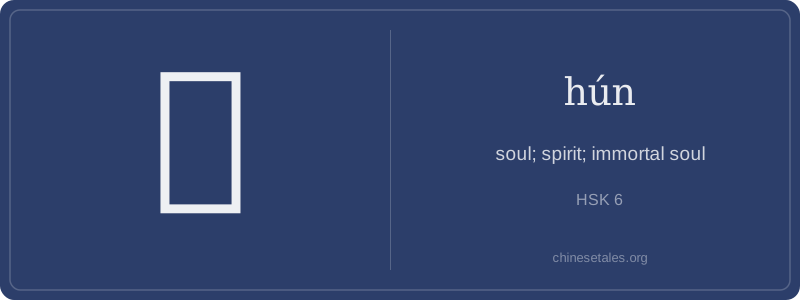
The earliest known form of 魂 appears on Warring States bamboo slips—not as a pictograph, but as a phonosemantic compound already fully formed: the left side 鬼 (guǐ, ‘ghost’) as semantic anchor, and the right side 云 (yún, ‘cloud’) as phonetic clue (note how ancient pronunciations linked *hún* and *yún* via voiced fricatives and nasal codas). Though 云 looks like ‘cloud’, here it’s purely sound-based—no weather involved! Over centuries, 云 simplified into the modern 云-like shape above 鬼, while 鬼 itself evolved from a kneeling figure with exaggerated head (oracle bone) into today’s stylized ghost with ‘ghost hat’ (厶) and ‘ghost legs’ (厶 + 丿丶).
This character crystallized during the Han dynasty, when cosmological texts like the *Huainanzi* formally distinguished 魂 (hún, ‘ethereal soul’, yang, active, ascending) from 魄 (pò, ‘corporeal soul’, yin, passive, descending). In classical poetry, 魂 became a vehicle for longing: Li Bai’s ‘my soul follows you ten thousand miles’ isn’t mystical—it’s emotional intensity made tangible. Visually, the floating 云 above the grounded 鬼 perfectly mirrors this duality: cloud-soul hovering over ghost-body—a stroke-by-stroke diagram of ancient Chinese psychology.
At its core, 魂 (hún) isn’t just ‘soul’ in the Western metaphysical sense—it’s the ethereal, yang-dominant, conscious, and mobile aspect of a person’s vital essence in traditional Chinese cosmology. Think of it as the part that dreams, wanders during sleep, departs at death, and may even haunt or inspire poets. Visually, it’s anchored by the radical 鬼 (guǐ, 'ghost'), instantly signaling its otherworldly domain—this isn’t your garden-variety spirit, but one deeply rooted in ancestral belief and Daoist-Buddhist syncretism.
Grammatically, 魂 is almost never used alone. It appears in tightly bound compounds (like 魂魄, 魂飞魄散) or metaphorical extensions: you don’t ‘have’ a soul—you ‘lose’ it (魂飞), ‘call’ it back (招魂), or ‘bind’ it (摄魂). Learners often mistakenly treat it like an English count noun and say *yī gè hún* ('one soul'), but native speakers rarely quantify it this way—instead, it’s inherently abstract, collective, and context-bound. Also beware: it’s never used for religious salvation (that’s 灵魂 in Christian contexts) nor for ‘spirit’ in ‘team spirit’ (that’s 精神).
Culturally, 魂 carries poetic gravity: Du Fu wrote of souls drifting like autumn leaves; modern writers use 魂 to evoke cultural memory—‘the soul of the Tang Dynasty’ doesn’t mean ghosts, but its living resonance. A common blunder? Confusing it with 魄 (pò), its yin counterpart—the physical, grounding life force that lingers in the body after death. Together, 魂 and 魄 form the complete human psyche—like breath and bone, thought and heartbeat.