魄
Character Story & Explanation
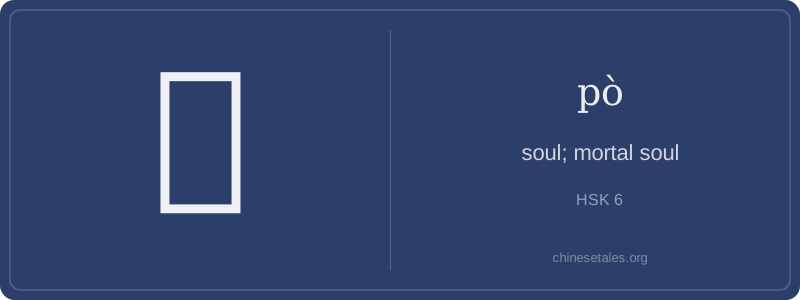
The earliest form of 魄 appears in bronze inscriptions around 1000 BCE — not as a ghostly figure, but as a stylized moon (⺌, later simplified to 白) beside a kneeling human figure (the ancestor of 鬼). That moon wasn’t celestial poetry: it represented *yin* light — cool, reflective, material — contrasting with the sun-associated 魂. Over centuries, the human evolved into the full 鬼 radical (ghost), while the moon became 白 (bái, ‘white’), phonetically hinting at pò’s pronunciation. By the Han dynasty, the character had stabilized into its current 14-stroke form: 鬼 + 白 — literally ‘ghost-white’, evoking the pale, physical essence that lingers after breath stops.
This duality shaped its meaning: in the Huáinánzǐ (2nd c. BCE), 魄 is explicitly defined as ‘the bodily soul formed from yin qi, governing the senses and movement’. Confucius himself referenced it indirectly — when he said ‘at seventy, I could follow my heart’s desires without overstepping boundaries’, scholars later interpreted this mastery as harmonizing hún and pò. Visually, the ghost radical doesn’t mean ‘scary’ here — it signals the *non-corporeal yet bodily* nature of this soul: invisible, but inseparable from flesh, breath, and bone.
Think of 魄 (pò) as the 'earthly soul' — the part of your spirit that’s tied to your body, breath, and vitality. Unlike 魂 (hún), the ethereal, wandering soul that departs at death, 魄 stays grounded: it governs instinct, physical courage, and raw presence. In classical Chinese cosmology, you’re born with your pò (from the mother’s yin energy), and it dissolves with the body. Modern usage leans poetic or literary: we don’t say ‘my pò is tired’ in daily chat — but we *do* say ‘a person with great pò’ to mean someone radiating unshakable charisma or moral fortitude.
Grammatically, 魄 rarely stands alone. It’s almost always in compounds like 胆魄 (dǎn pò, ‘courage and daring’) or 气魄 (qì pò, ‘magnificent presence’). You’ll never see it as a verb or adjective — no ‘pò-ed’ or ‘pò-ful’. A common mistake? Using it where English says ‘soul’ generically — but in Chinese, ‘soul’ is usually 魂 for spiritual journeys, 魄 for embodied strength. Saying ‘her 魄 left her body’ sounds like a medical report on vital signs, not a ghost story!
Culturally, 魄 carries quiet gravitas. It’s invoked in speeches about national resolve (e.g., ‘the pò of the Chinese people’), or in martial arts texts describing ‘calm pò under pressure’. Learners often overuse it trying to sound profound — but native speakers reserve it for moments of weighty authenticity. Think of it like ‘gravitas’ in English: powerful, but rare, and never casual.