魔
Character Story & Explanation
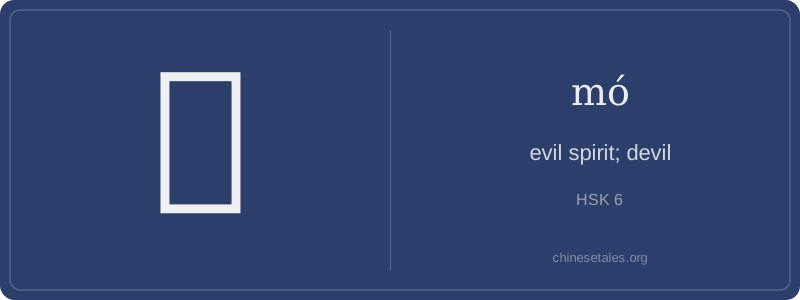
Oracle bone and bronze inscriptions have no direct precursor for 魔 — it’s a later creation, born from translation need. Its earliest form appears in Han dynasty bamboo texts as a phonosemantic compound: the left side 麻 (má, ‘hemp’ or ‘numbness’) provided sound, while the right-side radical 鬼 (guǐ, ‘ghost’) anchored meaning. Over centuries, the top of 麻 evolved into the distinctive ‘square-crown’ shape (麻 → ⺮ + 广 + 林), and the lower part fused with 鬼’s flowing, eerie strokes — resulting in today’s 20-stroke composition: a spectral figure wrapped in tangled, paralyzing fibers.
This visual logic reflects its Buddhist origin: 麻 evokes numbness, distraction, and sensory confusion — precisely what Māra does to meditators. In the *Sutra on the Ten Stages*, Māra appears as a celestial tempter who ‘shakes the bodhisattva’s mind like hemp leaves trembling in wind’. By Tang dynasty poetry, 魔 had shed strict religious weight and entered secular imagination — Li Bai wrote of ‘wine demons’ (酒魔) haunting poets, turning intoxication into a playful, internalized force. The character didn’t depict a monster — it mapped a mental state onto a ghostly silhouette.
At its heart, 魔 (mó) isn’t just ‘devil’ in the Western cartoonish sense — it’s a deeply atmospheric word that evokes *corrupting, seductive, otherworldly power*. Think less horned red demon, more a whisper in the dark that makes your resolve waver. It’s almost always used as a noun (‘a demon’, ‘the devil’) or in compound nouns (like 魔鬼 or 魔力), but crucially, it rarely stands alone in speech — you’ll almost never hear someone say ‘That’s a mó!’ like ‘That’s a ghost!’ Instead, it lives inside vivid, culturally loaded phrases.
Grammatically, 魔 shines in descriptive compounds: 魔鬼 (móguǐ, ‘devil’) is common and neutral; 魔力 (mólì, ‘magic power’) is positive and poetic; while 魔怔 (mōzheng, colloquial for ‘obsessive delusion’) shows how it can describe psychological states — not just supernatural beings. Learners often mispronounce it as ‘mò’ (4th tone), but it’s firmly ‘mó’ (2nd tone), matching the rising, insinuating quality of its meaning.
Culturally, 魔 carries Buddhist baggage — it entered Chinese via Sanskrit *māra*, the personification of temptation and spiritual obstruction. So when someone says 他被魔障了 (tā bèi mó zhàng le), they’re not joking about possession — they’re invoking centuries of Chan/Zen discourse about inner obstacles to enlightenment. Don’t use it lightly in formal writing; it’s dramatic, literary, and often metaphorical — unlike the blunter 鬼 (guǐ, ‘ghost’), which is everyday and literal.