黎
Character Story & Explanation
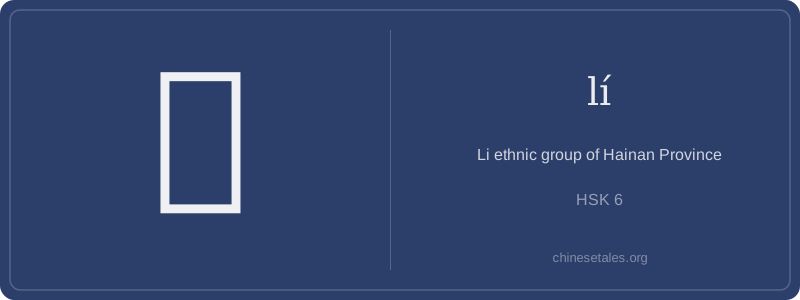
The earliest form of 黎 appears in late Western Zhou bronze inscriptions as a complex pictograph: at the top, a stylized grain stalk (黍 shǔ, millet), below it a kneeling figure (with arms raised), and beneath that, a fire or hearth symbol (灬). This wasn’t just 'grain + person + fire' — it depicted ritual millet-offering before ancestral flames, a sacred act tied to communal identity and land stewardship. Over centuries, the kneeling figure simplified into the '禾' component on the left, the millet stalk evolved into the top part of 黍, and the four dots (灬) remained firmly at the bottom — preserving the fire/hearth element that anchors the character’s warmth and rootedness.
By the Han dynasty, 黎 had shifted from ritual action to ethnic designation — first appearing in texts like the Hou Hanshu to refer to southern peoples of Hainan and Guangxi. Its visual weight — the heavy, grounded 'fire' base — subtly reinforced notions of enduring cultural flame and ancestral continuity. Poets like Li Bai later used 黎 in poetic compounds like 黎明 (lí míng, 'dawn'), borrowing its 'first light after darkness' resonance — but this sense is purely metaphorical and derived; the core, living meaning remains tethered to the Li people and their island home.
Think of 黎 (lí) like the 'Celtic' of Chinese ethnic terminology — not a generic word for 'people', but a precise, culturally anchored label, much like how 'Celtic' instantly evokes specific languages, music, and island traditions rather than just 'European'. In Chinese, 黎 almost exclusively refers to the Li people of Hainan — an officially recognized ethnic minority with distinct weaving traditions, betel nut culture, and a language unrelated to Mandarin. It’s never used as a standalone noun like 'the Li'; instead, it appears only in compound terms: 黎族 (Lízú, 'Li ethnic group'), 黎锦 (Líjǐn, 'Li brocade'), or in formal contexts like government documents or ethnographic reports.
Grammatically, 黎 behaves like a proper noun prefix — it doesn’t take measure words, can’t be modified by adjectives like 'big' or 'small', and never appears without its partner character (usually 族, 锦, or 话). Learners often mistakenly try to use it like 汉 (Hàn, 'Han') — e.g., saying *黎人* ('Li people') — but that’s archaic or poetic; modern usage requires 黎族. Even more common: confusing it with the homophone 犁 (lí, 'plow'), which shares the sound but zero semantic overlap — a slip that could turn an anthropology essay into agricultural machinery manual!
Culturally, 黎 carries quiet authority: it’s one of only 56 officially designated ethnic group names in China, each carrying constitutional weight. Mispronouncing it as lí instead of the correct second tone (lí, not lì or lí) may seem minor — but tone errors here risk misidentifying an entire ethnic group in academic or official speech. And unlike characters like 汉 or 回, 黎 has no everyday metaphorical use (no 'Li dawn', no 'Li light'); its meaning is fiercely specific, grounded, and respectfully bounded.