党
Character Story & Explanation
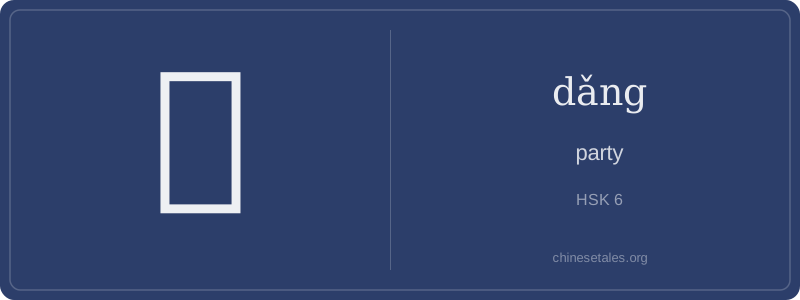
The earliest form of 党 appears in bronze inscriptions from the Western Zhou (c. 1046–771 BCE), where it looked like a person (亻) standing beside two parallel lines (two strokes resembling 儿), sometimes with a roof-like top (尚). Over centuries, the top simplified into 尚 (shàng, 'still, yet'), and the bottom evolved from a pictograph of two people standing together into the modern 儿 (ér, 'child') radical — though this is now purely phonetic and structurally misleading. Crucially, the original idea wasn’t 'child' but 'together': the two vertical strokes symbolized unity or alignment — like two people shoulder-to-shoulder under one roof, forming a group bound by loyalty or interest.
This visual metaphor shaped its meaning: in the *Analects*, Confucius warns *qún ér bù dǎng* ('form groups but do not form cliques'), highlighting 党’s early sense of biased factionalism. By the Han dynasty, it was used in legal texts to denote organized associations — sometimes outlawed, sometimes sanctioned. The modern simplification (in 1956) preserved 尚 + 儿, but the 'child' radical now masks its origin as a symbol of collective action. Interestingly, the character’s shape echoes its semantic core: the upper part 尚 suggests 'still upholding', the lower 儿 hints at human bonds — together, 'those who still uphold shared ideals'.
At first glance, 党 (dǎng) feels like a straightforward 'party' — but it’s way more charged than that. In Chinese, it carries strong institutional weight: think political party (especially the CPC), tight-knit factions, or even old-school secret societies. Unlike English 'party', which can be festive or casual (a birthday party), 党 almost always implies organization, allegiance, and often hierarchy. It’s never used for social gatherings — you’d never say *shēngrì dǎng* for 'birthday party'; that’s *shēngrì pàiduì* or just *pàiduì*.
Grammatically, 党 is a noun that rarely stands alone without modifiers — you’ll see it in compounds like 共产党 (Communist Party) or in phrases like 加入党 (join the party). It doesn’t take aspect particles (了, 过) directly — you don’t say *dǎng le*, but *rùdǎng le* ('has joined the party'). Also, it’s never reduplicated (no *dǎngdǎng*) and isn’t used adjectivally without structure — you wouldn’t say *dǎng de rén* for 'party people'; it’s *dǎngyuán* ('party member') or *dǎngwài* ('outside the party').
Culturally, learners often misread its neutrality: while English 'party' can be apolitical, 党 is inherently ideological in modern usage. Even in classical texts (like the *Zuo Zhuan*), 党 meant 'clique' or 'faction' — often with a slightly negative connotation of partiality. That legacy lingers: calling someone *yǒu dǎngxìng* ('has party consciousness') sounds formal and political; calling them *dǎngtóng* ('party comrade') is deeply contextual — warm among members, awkward or ironic otherwise.