庞
Character Story & Explanation
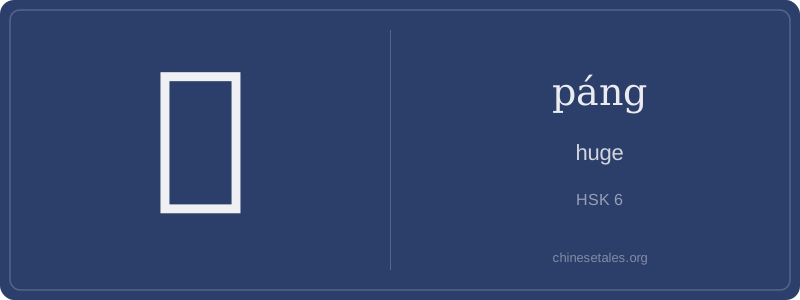
The earliest form of 庞 appears in bronze inscriptions (Zhōu dynasty), where it combined 广 (guǎng, 'roof; broad shelter') with 龙 (lóng, 'dragon') — not as a phonetic component, but as a semantic amplifier: a dragon sheltered under a vast roof, symbolizing immense, protective grandeur. In seal script, the dragon simplified into two curved strokes beneath the 广 radical, eventually becoming the right-side element 尨 (máng), meaning 'shaggy' or 'hairy' — reinforcing visual bulk. By the Han dynasty clerical script, the form stabilized: 广 (3 strokes) on the left, 尨 (5 strokes) on the right — totaling eight strokes, with the top dot and sweeping horizontal stroke of 广 framing the dense, layered strokes below.
This evolution reflects how meaning deepened: from literal 'dragon under a great roof' → 'shaggy, thick, abundant' (尨) → 'massive in scope or appearance' (庞). In classical texts like the *Zhuāngzǐ*, 庞 appears in phrases like 庞然大物 to describe creatures whose sheer size dwarfs human perspective — not threatening by intent, but by scale alone. The character’s visual heft — broad top, dense lower half — mirrors its semantic weight: it doesn’t shout 'big'; it *occupies space* on the page and in the mind.
Imagine standing at the base of the Terracotta Army’s largest warrior — not just tall, but overwhelming in presence: broad shoulders, massive armor plates, a gaze that seems to hold centuries. That’s 庞 (páng): not merely 'big' like 大 (dà), but *viscerally imposing*, *architecturally vast*, or *intimidatingly large*. It’s the size that makes you step back — a庞然大物 (páng rán dà wù), a 'huge, looming thing'. Unlike 大 or 巨 (jù), 庞 carries weight, density, and often a hint of unease — think of a庞杂的系统 (páng zá de xìtǒng), a 'vast, unwieldy system' where scale breeds complexity.
Grammatically, 庞 is almost never used alone. It appears almost exclusively in fixed compounds or as the first character in four-character idioms (chéngyǔ). You won’t say *‘this house is 庞’* — that’s ungrammatical. Instead, it modifies nouns or adjectives: 庞大 (pángdà, 'enormous'), 庞杂 (pángzá, 'vast and intricate'), 庞然 (pángrán, literary prefix meaning 'massively'). It’s also common in classical-style descriptions: 庞眉皓首 (páng méi hào shǒu) — 'bushy eyebrows and white hair', evoking an august, venerable elder.
Culturally, 庞 subtly conveys awe mixed with mild apprehension — think of imperial palaces, ancient mountains, or bureaucratic hierarchies. Learners often mistakenly use it as a standalone adjective (like ‘big’) or confuse it with 壮 (zhuàng, 'robust') or 宏 (hóng, 'grand, majestic'). Remember: 庞 is about *overwhelming physical or systemic scale*, not strength or nobility. Its power lies in its restraint — it only speaks through compound forms, making it a quiet giant among characters.