筲
Character Story & Explanation
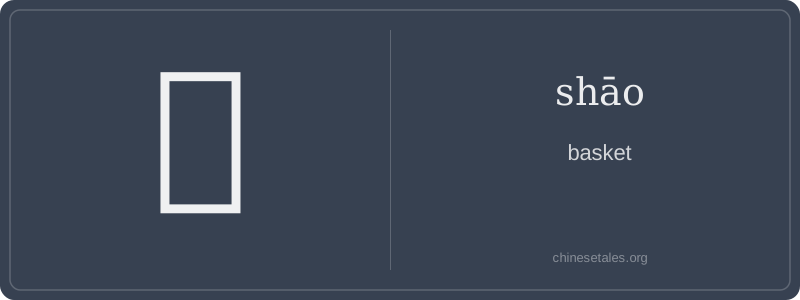
The earliest form of 筲 appears in Han dynasty bamboo slips and clerical script — not oracle bone, since it’s a later invention tied to bamboo craftsmanship. Visually, it’s a masterclass in semantic logic: the top ⺮ (bamboo radical) tells you the material; the bottom 少 (shǎo, 'few') is *not* about quantity, but a phonetic clue — ancient pronunciation was closer to *shāo*, and 少 provided that sound anchor. Over centuries, the character stabilized: the two bamboo 'hats' (⺮) became standardized, and 少 simplified from its fuller seal-script form into today’s three-stroke shape — giving us the clean 13-stroke structure we write now.
This character didn’t emerge from nature or ritual — it was born from labor. By the Tang and Song dynasties, 筲 appeared in agricultural manuals and poetry describing granaries, kitchens, and riverside markets. In the classic *Dream of the Red Chamber*, servants carry '竹筲' (zhú shāo) to rinse tea leaves — a quiet detail that grounds the opulent world in tactile, everyday tools. The visual harmony is intentional: bamboo above (light, flexible, growing upward), 少 below (compact, grounded, containing) — together, they embody containment through craft, not force.
Think of 筲 (shāo) not as just 'basket' but as a *specific kind* of basket — one made of split bamboo, woven tightly, and traditionally used for scooping or measuring grain, rice, or water. It’s not the generic 篮 (lán) you’d use for a basketball hoop or shopping bag; 筲 feels humble, functional, and quietly precise — like a bamboo ladle with handles. In classical and literary Chinese, it often appears in metaphors about modest capacity: 'a shāo of wisdom' implies something small but earnest, never boastful.
Grammatically, 筲 is almost always a noun and rarely stands alone — it shows up in compounds (like 筲箕 or 竹筲) or poetic phrases. You won’t say 'I bought a shāo'; you’ll hear it in fixed expressions like '一筲米' (yī shāo mǐ) — 'one measure of rice', where 筲 functions like a traditional unit, much like 'a bushel' in English. Learners sometimes mistakenly use it as a verb ('to scoop') — but no, it’s strictly nominal. If you want to scoop, use 撮 (cuō) or 舀 (yǎo).
Culturally, 筲 evokes rural China before plastic buckets: think farmers at dawn, lifting rice from a storage bin with this open-topped, handle-equipped basket. Its absence from HSK isn’t due to rarity, but its register — it’s more likely found in literature, local dialects, or heritage crafts than in daily conversation. A common slip? Confusing it with 稍 (shāo, 'slightly'), which sounds identical but means something totally different — and shares zero strokes. Listen closely: tone and context are your lifeline here!