鿏
Character Story & Explanation
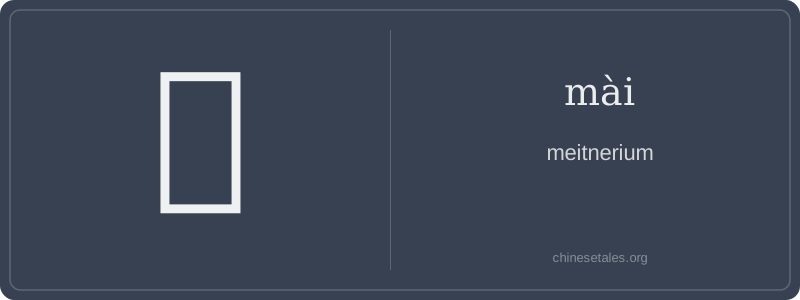
The character 鿏 has no oracle bone or bronze script ancestry — it was forged in a lab, not a Shang dynasty foundry. Its earliest attested form appears in the 1997 Chinese Chemical Society’s Standard Nomenclature for Elements. Visually, it’s a fusion: the top is the traditional form of 卖 (mài, ‘to sell’), which itself evolved from a pictograph of a net over a head (indicating trade), and the bottom is 鳥 (niǎo, ‘bird’), preserved from the archaic seal-script variant of 卖. So every stroke was chosen deliberately — not for meaning, but for sound and bureaucratic consistency.
This character never meant anything before 1997. No Confucian text mentions it; no Tang poet rhymed with it. Its entire semantic life began when Chinese chemists needed a unique, pronounceable, non-homophonic character for element 109 — honoring Lise Meitner, but avoiding conflict with existing characters like 麦 (mài, ‘wheat’) or 脉 (mài, ‘pulse’). The choice of 鳥 as the radical wasn’t symbolic — it was orthographic necessity: the traditional 卖 had 鳥 embedded, so preserving that form ensured visual distinction from simplified 卖. Thus, a bird radical ‘represents’ nothing but calligraphic lineage — a rare case where history trumps logic in modern Chinese character creation.
Let’s be honest: 鿏 (mài) is a linguistic unicorn — it doesn’t exist in classical Chinese, wasn’t used for millennia, and isn’t in any dictionary older than 1997. It’s a *deliberate neologism*, invented solely to name the synthetic chemical element meitnerium (Mt, atomic number 109). Unlike most Chinese characters, it carries zero semantic baggage from ancient philosophy or daily life — no poetry, no idioms, no historical weight. Its ‘meaning’ is purely scientific and administrative: a label, not a concept.
Grammatically, 鿏 behaves like any elemental character (e.g., 氧 yǎng 'oxygen', 铁 tiě 'iron'): it only appears in compound nouns, never alone or as a verb/adjective. You’ll see it exclusively in terms like 'meitnerium atom' or 'element 109'. Crucially, it *never* takes measure words, never appears in colloquial speech, and never shows up in HSK exams — because it literally has no role outside nuclear chemistry textbooks and IUPAC nomenclature committees.
Culturally, 鿏 is a fascinating artifact of modern standardization. When China adopted the official names for transuranic elements in the late 1990s, linguists followed strict rules: new elements get characters with the metal radical (钅) + a phonetic component matching the element’s international name. But here’s the kicker — 鿏 uses the *bird radical* (鳥), not the metal radical! That’s because its phonetic component is 卖 (mài), and the traditional form of 卖 contains 鳥. So this ‘metal’ element hides a bird — a delightful, ironic glitch in an otherwise rigid system. Learners often mistakenly assume it’s related to birds or selling — a classic trap born of trusting radicals too literally.