丂
Character Story & Explanation
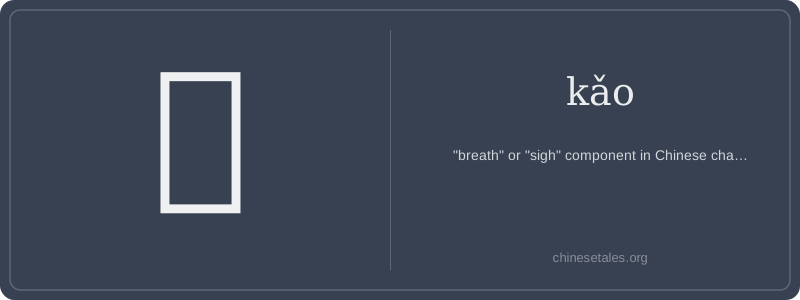
Carved into oracle bones over 3,200 years ago, the earliest form of 丂 resembled a stylized mouth (口) with a single wisp of vapor curling upward — not smoke, not steam, but *breath*: a thin, elegant curve rising from the lips. Over centuries, the mouth shrank to a dot or vanished entirely, and the breath-curve hardened into a crisp, rightward-flicking stroke attached to a base line. By the seal script era, it had simplified to just two strokes: the foundational horizontal (一), representing the ground or the mouth’s baseline, and the ascending hook — not sharp like 亅, but soft and rounded, mirroring the shape of air lifting off the tongue. No ink was wasted; every curve served meaning.
This breath-symbol didn’t stay literal. In classical texts like the *Shuōwén Jiězì* (121 CE), Xu Shen defined 丂 as 'qì chū yě' — 'the emergence of breath' — linking it to vitality and authenticity. When scribes added it to 老 (old), they weren’t drawing wrinkles — they were marking the elder’s enduring breath, the life-force still present. In 孝 (filial piety), the 丂 sits atop 子 (child), visualizing breath — devotion — rising *toward* parents, like incense smoke ascending in ritual. Its evolution is silent poetry: from visible vapor to invisible ethos.
Forget everything you know about 'characters meaning things' — 丂 (kǎo) isn’t used alone in modern Chinese. It’s a ghost of breath: a fossilized component hiding inside characters like 考 (kǎo, 'to examine'), 老 (lǎo, 'old'), and 孝 (xiào, 'filial piety'). Visually, it’s just two strokes — a horizontal line (一) and a short, upward-curving hook (亅-like but distinct) — yet ancient scribes saw it as the *exhalation* of life: air rising from the mouth, a sigh escaping the chest. That’s why it appears in words tied to human vitality, aging, and moral resonance — not as a standalone word, but as semantic DNA.
Grammatically, 丂 never stands alone — no verbs, no nouns, no dictionary entries for it by itself. You’ll only encounter it embedded: in 考, it subtly reinforces the idea of *breathing scrutiny* (examining closely, as if inhaling truth); in 老, it evokes the slow, deep breaths of elders; in 孝, it suggests breath offered *upward* — respect flowing from child to ancestor, like vapor rising. Learners often mistakenly search for 丂 in dictionaries or try to pronounce it in isolation — a dead end. It’s not a word; it’s a whisper in the architecture of meaning.
Culturally, this character is a quiet testament to how Chinese writing encodes philosophy in form: breath = life = judgment = reverence. Mistaking it for a functional character leads to confusion with radicals like 丿 (piě, 'slash') or 亅 (jué, 'hook'), but 丂’s curve is uniquely gentle, almost hesitant — like an exhalation that hasn’t quite left the body. Its power lies entirely in its invisibility: you don’t read 丂 — you feel its presence in every 'kǎo' sound and every bowed head.