丌
Character Story & Explanation
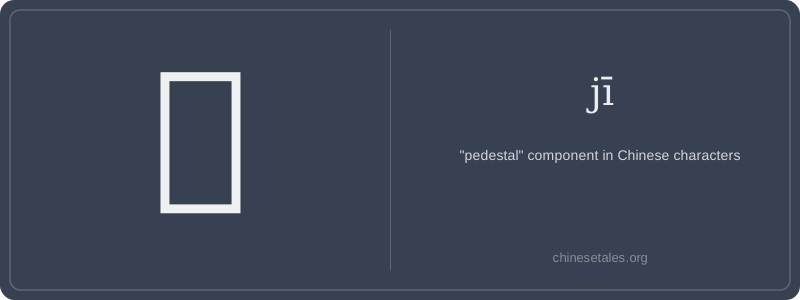
Carved into oracle bones around 1200 BCE, 丌 began as a vivid pictograph: a low, wide platform with two supporting legs — think of a bronze ritual stand holding a sacred vessel. The earliest forms show three clear elements: a thick horizontal line (the tabletop), and two downward strokes angled outward like sturdy posts. Over centuries, the legs simplified from curved supports into clean diagonal strokes, while the top bar stayed broad and grounded. By the seal script era, the shape had settled into its modern minimalist form: one horizontal stroke crowned by two diverging diagonals — unmistakably a base designed to bear weight.
This visual logic carried directly into meaning. In classical texts like the Rites of Zhou, platforms (丌) were central to state rituals — elevating offerings to heaven, grounding oaths in earth. Though 丌 vanished as an independent word after the Warring States period, its silhouette endured in characters tied to ceremony, possession, and authority. Its persistence isn’t about sound or syntax — it’s about posture: the unspoken cultural insistence that every meaningful thing must have something solid beneath it.
丌 (jī) isn’t a character you’ll see on street signs or hear in daily conversation — it’s a quiet architectural ghost, a structural footnote that lives almost exclusively as a component inside other characters. Its core meaning is 'pedestal' or 'base', evoking the ancient Chinese reverence for stable foundations: not just physical ones like altar platforms or ritual stands, but philosophical ones — the groundedness beneath authority, ceremony, and cosmic order. You won’t find 丌 used alone in modern texts; it’s a silent scaffold, visible only when you dissect characters like 其 (qí, 'its'), 具 (jù, 'to possess'), or 典 (diǎn, 'canon').
Grammatically, 丌 has zero standalone function — no verbs, no particles, no adjectives. It appears only as a semantic radical or historical residue in compound characters. For example, in 具 (jù), the top part is a stylized 丌 (base) + two hands (廾), literally 'hands placing something on a pedestal' → 'to possess' or 'to prepare'. Learners sometimes misread it as 一 (yī, 'one') or 丁 (dīng), but 丌’s three strokes form a deliberate, asymmetrical T-shape: horizontal, then left-down, then right-down — like legs splayed to support weight.
Culturally, 丌 reveals how Chinese writing encodes hierarchy and stability at the stroke level: even abstract concepts rest on invisible platforms. A common mistake is overpronouncing it — since it never appears independently, many learners don’t know its reading jī at all. And crucially: never try to use it in speech or writing on its own. It’s not archaic — it’s *architectural*. Like finding a single floor joist labeled 'support beam' in your house manual: essential, unseen, and never meant to be admired solo.