丏
Character Story & Explanation
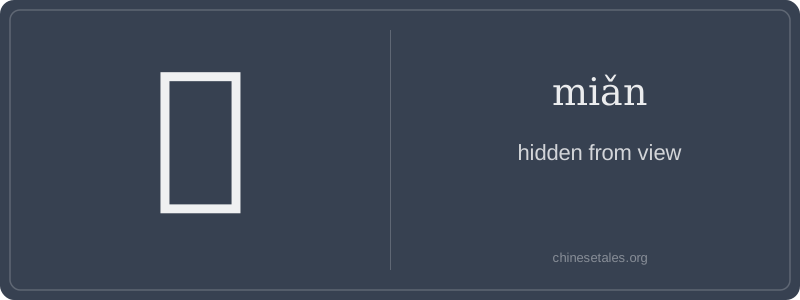
The earliest form of 丏 appears in late Warring States bamboo slips as a simple horizontal line (一) capped by two short, downward-curving strokes — like a roof shielding a space beneath. Scholars believe it depicted a person crouching low under cover, their silhouette reduced to a minimal shape: the top stroke as shelter, the two side strokes as bent arms or knees, and the bottom stroke (the radical 一) as the ground. Over centuries, the curves simplified into straight diagonal strokes, and the ‘roof’ flattened — until by the Han dynasty clerical script, it stabilized into today’s clean, compact 丏: four strokes total, perfectly balanced and deeply economical.
This visual economy shaped its meaning. In the Zuo Zhuan, 丏 appears in phrases like '丏面不仕' — 'hid his face and refused office' — describing officials who withdrew from corruption rather than confront it. The character’s very shape mirrors this act: no flourish, no excess — just essential lines holding space for silence. Later, in Tang poetry, 丏 took on gentle connotations of modesty: '丏名' (hidden name) meant publishing anonymously, not out of fear, but to let the work speak unburdened by ego. Its meaning never drifted toward negativity — always retaining a quiet, principled gravity tied to its stark, sheltering form.
Imagine you’re peeking through a crack in an old wooden door — just enough to glimpse a sliver of moonlight, but the rest is swallowed by shadow. That’s the feeling of 丏 (miǎn): not gone, not erased — just deliberately concealed, withdrawn from sight. It’s not about blindness or absence; it’s quiet, intentional hiding — like a scholar retreating from court politics, or a secret kept behind closed lips. In classical usage, it often modifies verbs or nouns to convey concealment, obscurity, or humility: '丏言' (miǎn yán) means 'guarded speech', not 'silent speech' — a subtle distinction learners miss.
Grammatically, 丏 almost never stands alone in modern Chinese. It’s a literary morpheme that appears only in fixed compounds (like 丏面, 丏言, 丏名), usually as a prefix meaning 'hidden/veiled'. You won’t find it in spoken Mandarin or beginner texts — and that’s why typing 'miǎn' in most input methods won’t even suggest it! Learners mistakenly try to use it like a verb ('他丏了') or adjective ('这个很丏'), but it’s strictly bound to classical-style compound words. Its presence signals formality, restraint, or poetic understatement — think ink-wash painting where emptiness speaks louder than brushstrokes.
Culturally, 丏 embodies a Daoist and Confucian ideal: the power of withdrawal. Unlike Western 'hiding' (which implies shame or danger), 丏 suggests dignity in reserve — the sage who doesn’t shout truth but lets it emerge quietly. A common mistake? Confusing it with 免 (miǎn, 'to avoid') — same pinyin, opposite energy: one pulls back into stillness, the other actively dodges. Misreading 丏 as 免 turns 'veiled intention' into 'avoided intention' — a philosophical chasm in four strokes.