丳
Character Story & Explanation
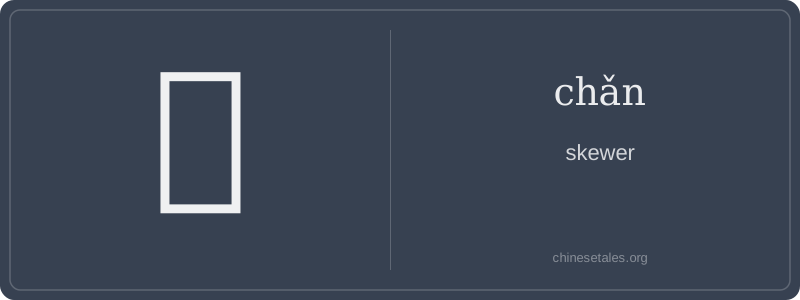
The earliest form of 丳 appears in Western Zhou bronze inscriptions as two parallel vertical strokes (like ||) with a short horizontal bar crossing them near the top — a clear pictograph of a straight rod with a stopper or handle at one end, designed to prevent food from sliding off. Over centuries, the top bar thickened, the two main strokes became more angular, and by the Small Seal Script, it stabilized into its current minimalist shape: two verticals and one short crossbar — no frills, no flourishes, just functional geometry.
This stark visual economy mirrors its semantic journey: from a concrete kitchen tool in oracle bone records (used in sacrificial roasting) to a literary marker of precision and control in texts like the Zuo Zhuan, where '丳肉' (chǎn ròu) meant 'meat properly secured for ritual grilling'. Its meaning never broadened — unlike 筷 or 叉 — because its purpose was singular: to fix, align, and elevate. Even today, chefs in Xi’an refer to the ideal 丳 as one that 'holds the lamb like a scholar holds truth — firm, upright, unyielding.'
Imagine a bustling Tang dynasty night market in Chang’an — sizzling lamb skewers turning over open coals, the vendor calling out 'chǎn! chǎn!' as he threads tender morsels onto long iron rods. That sharp, percussive chǎn isn’t just sound effect — it’s the very word for the skewer itself: 丳. This character isn’t abstract; it’s tactile, visceral, and deeply culinary. It names the tool that transforms raw meat into street-food art — always a rigid, piercing implement, never flexible or decorative.
Grammatically, 丳 is almost exclusively a noun (rarely a verb in classical texts meaning 'to pierce with a skewer'), and it’s highly specific: you wouldn’t say *wǒ yòng yī gè 丳* ('I used a skewer') in modern speech — it’s archaic or literary. Instead, you’ll meet it in compound words like 烤丳 (kǎo chǎn, 'grilled skewer') or historical descriptions. Learners often misread it as a variant of 刂 (knife radical) or confuse it with 炙 (zhì, 'to roast'), but 丳 carries no fire element — its power lies in penetration, not heat.
Culturally, 丳 evokes ritual and craft: ancient bronze inscriptions show it used in ancestral offerings where meat was pierced and presented intact. Today, it survives most vividly in regional dialects (e.g., Shandong opera scripts) and food anthropology texts. A common mistake? Assuming it’s interchangeable with 筷 (kuài, 'chopsticks') — but while chopsticks grasp, 丳 impales. That distinction — hold vs. pierce — is baked into the character’s very bones.