丵
Character Story & Explanation
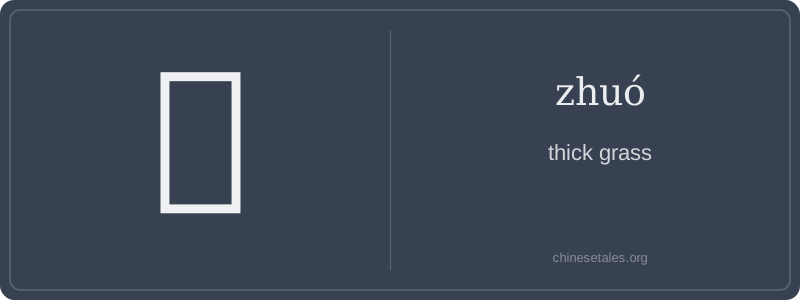
Carved onto oracle bones over 3,000 years ago, the earliest form of 丵 looked like three upward-tapering blades sprouting from a shared base — a stylized cluster of stiff, sharp-edged grasses. Over centuries, the top elements simplified into two 'grass-like' strokes (艹 variant), while the lower part evolved from a pictograph of tangled roots into the distinctive 'three short horizontal lines stacked above a long vertical' (彐 + 丨). By the Small Seal Script era, the structure solidified: the central vertical stroke (丨) became the backbone — representing the dominant stem — flanked by three uneven horizontals suggesting overlapping leaves or stems crowding together.
This visual logic never strayed far from meaning: each horizontal stroke is a layer of vegetation; the vertical is the axis holding them all upright — not neat or cultivated, but vigorous and intertwined. In the Shuō Wén Jiě Zì (121 CE), Xu Shen defined it as 'cǎo mào yě' (grass thick and luxuriant), citing its use in describing uncultivated margins of fields. Tang poets like Wang Wei used 丵 implicitly in landscape couplets where 'the path disappears beneath 丵-mǎng' — not as literal vocabulary, but as the aesthetic weight behind words like 莽 (mǎng, wilderness). Its shape *is* its meaning: a compact glyph of botanical insistence.
丵 (zhuó) is a poetic, almost forgotten word for 'thick, tangled grass' — not just any grass, but the kind that grows wild, dense, and stubbornly untamable, like reeds choking a riverbank or bamboo thickets swallowing an old path. In classical Chinese, it evokes a sense of primordial abundance and quiet resistance: nature asserting itself without human permission. You won’t hear it in daily speech — no one says 'let’s mow the 丵' — but it lives on in literary descriptions of wilderness, decay, or serene desolation.
Grammatically, 丵 functions as a noun, often modified by adjectives like 茂 (mào, lush) or 荒 (huāng, desolate), and appears almost exclusively in compound words or parallel phrases in classical poetry and historical texts. It rarely stands alone — you’ll see it in phrases like 丵莽 (zhuó mǎng, 'dense wild growth') or paired with characters like 莽, 葛, or 薇 to build layered natural imagery. Learners might mistakenly treat it as a verb or try to use it colloquially; resist that urge — its power lies precisely in its restraint and antiquity.
Culturally, 丵 reflects the Chinese literati’s deep attention to micro-textures of landscape: not just 'grass', but *how* grass grows — thick, interwoven, uncut, alive with hidden life. Modern learners often misread its radical (丨, 'gǔn', vertical line) as merely decorative, but it anchors the character visually and semantically: the central stroke represents the upright stalks piercing through the tangled mass below. Confusing it with similar-looking characters (like 业 or 丄) is common — but 丵 isn’t about duty or height; it’s about density, entanglement, and the quiet persistence of wild green.