丶
Character Story & Explanation
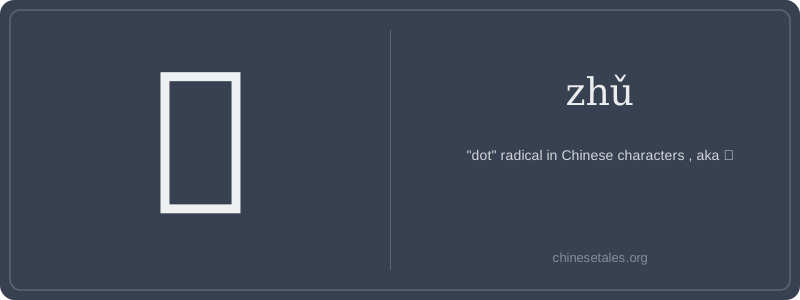
Carved onto oracle bones over 3,200 years ago, 丶 began as a tiny, deliberate puncture — not a brushstroke, but a sharp, downward tap made with a bone stylus into wet clay or turtle plastron. Archaeologists call it a ‘divinatory dot’: priests would inscribe questions to ancestors, then apply heat until cracks formed; the initial dot marked where the crack would originate. Over centuries, bronze inscriptions refined it into a clean, slightly tilted dot, and by the clerical script era (c. 200 BCE), it stabilized into the perfectly balanced, isolated dot we know — always unconnected, always self-contained, never fused with adjacent strokes.
This punctual origin shaped its semantic destiny: 丶 came to symbolize the ‘origin point’, the ‘seed moment’ before action — a concept echoed in classical texts like the *Yi Jing* (I Ching), where the ‘first line’ of a hexagram is sometimes glossed as 丶之始 (zhǔ zhī shǐ, 'the beginning of the dot'). Its meaning never drifted into ‘smallness’ or ‘insignificance’ — quite the opposite. In traditional calligraphy theory, masters taught that ‘a single 丶 holds the qi of the entire character’ — a silent command to begin with intention. Even today, when teachers circle the topmost dot in 之 or 主, they’re tracing a lineage back to Bronze Age divination.
Meet 丶 — the tiniest radical in Chinese, pronounced zhǔ (like 'joo' with a rising tone), and visually just a single dot. Don’t let its size fool you: this isn’t a punctuation mark like English ‘.’, nor is it the common word for ‘dot’ (點/点, diǎn). Instead, 丶 is a *radical* — a structural building block used almost exclusively in dictionary indexing and character analysis. You’ll never see it standing alone in modern writing, but you’ll find it lurking inside characters like 之 (zhī, 'of'), 乏 (fá, 'lacking'), and 丸 (wán, 'pellet') — always perched at the top-left or uppermost position as a subtle visual anchor.
Grammatically, 丶 has zero standalone function — no verbs, no particles, no sentence roles. It’s not used in speech or typing; even native speakers rarely pronounce it outside linguistics class. Confusing it with 点 (diǎn) is the #1 learner trap: saying 'diǎn' when you mean the radical 丶 is like calling a ‘car chassis’ a ‘steering wheel’ — related, but fundamentally different categories. If you type ‘dian’ into a Chinese input method, you’ll get 点, never 丶 — the latter must be inserted via Unicode or radical lookup.
Culturally, 丶 embodies Chinese script’s reverence for minimalism and structural logic: one stroke, zero ambiguity in form, yet immense functional weight in lexicography. Ancient scholars treated radicals like DNA markers — and 丶, being the simplest, was historically called the ‘first stroke of heaven’ (天之首筆). Learners often overthink it; the truth? Respect it, recognize it, then move on — it’s the quiet librarian of Chinese characters, organizing the library but never checking out books.