丷
Character Story & Explanation
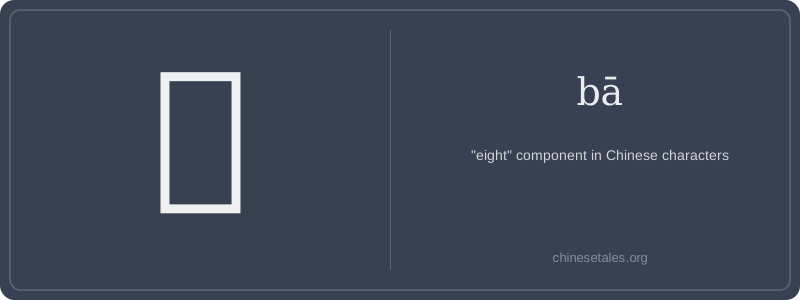
The earliest form of 丷 appears in Shāng dynasty oracle bone inscriptions as two short, slanted lines diverging downward from a central point — likely a stylized depiction of a split or opening, perhaps mimicking parted lips, a cracked shell, or even the bifurcated horns of a sacrificial ox. Over centuries, the central connection faded entirely, leaving just the two clean, independent strokes we know today. Bronze script refined them into sharper, more deliberate angles; by the small seal script era, they’d become perfectly mirrored — like twin raindrops falling from a leaf’s tip. This elegant reduction wasn’t laziness — it was precision: distilling 'division' into its purest visual essence.
This 'splitting' concept anchored its semantic role in classical texts. In the Shuōwén Jiězì (121 CE), Xu Shen classified 丷 as a 'dividing' component, linking it to characters involving separation, revelation, or emergence — like 光 (light appearing when darkness parts) and 兌 (an exchange requiring mutual opening). The link to 'eight' is purely phonetic coincidence: early pronunciations of words containing 丷 happened to sound like *ba*, leading later lexicographers to name the component after the homophonous numeral. So while your ear hears 'eight', your eye sees 'open' — a delightful, enduring pun built into the script’s DNA.
Think of 丷 not as a standalone word, but as the Chinese equivalent of the Latin prefix 'bi-' or 'duo-' — it’s a silent, structural whisper of 'two' or 'duality', embedded like a watermark in dozens of characters. Though it’s named after the number eight (bā), its visual form — two downward strokes like open arms or parted curtains — has nothing to do with quantity; instead, it evolved from an ancient symbol meaning 'to divide' or 'to separate'. You’ll never see 丷 alone on a menu or in speech — it only lives inside other characters, like a backstage stagehand who never takes a bow.
Grammatically, 丷 functions purely as a component — never as a word, never as a radical that carries semantic weight on its own (unlike 氵 for water or 心 for heart). It appears at the top of characters like 光 (guāng, 'light'), 兄 (xiōng, 'older brother'), and 兑 (duì, 'exchange'). Learners often mistakenly try to pronounce it independently or confuse it with the numeral 八 (bā) — but while 八 is bold, angular, and stands alone, 丷 is delicate, symmetrical, and always in service: two strokes holding up meaning like a lintel over a doorway.
Culturally, 丷 is a master of disguise: its shape echoes the yin-yang duality principle — not opposites fighting, but complementary forces balanced in stillness. A common mistake? Assuming all characters with 丷 relate to 'eight' — they don’t. In fact, none do. Its presence signals historical derivation from 'splitting' or 'opening', not counting. Even native speakers rarely think about it — which makes it the perfect linguistic ghost: ubiquitous, invisible, and utterly essential to the architecture of written Chinese.