丼
Character Story & Explanation
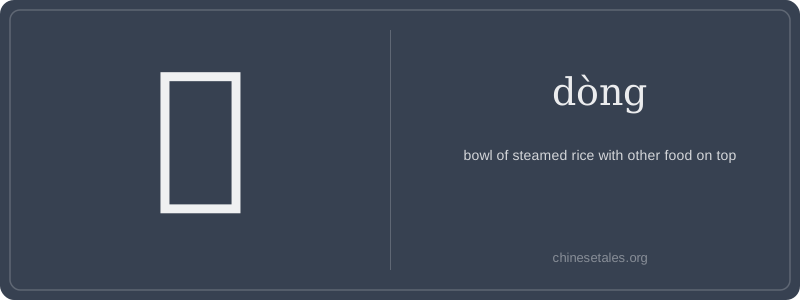
The character 丼 is actually a simplified form of the ancient Chinese character 井 (jǐng), meaning 'well'. Oracle bone inscriptions show 井 as a clear cross-shaped pictograph — four lines meeting at right angles, representing the wooden frame lining an ancient water well. Over time, seal script stylized it into a symmetrical + shape, and clerical script added slight curves. The modern 井 retains that iconic grid. 丼 emerged later in Japan as a variant — adding a dot (丶) in the center to distinguish the food term from the 'well' character. That tiny dot wasn’t philosophical; it was practical branding — like slapping a logo on a borrowed word.
In classical Chinese, 井 meant 'well', 'neighbourhood unit' (in ancient city planning), or even 'order and structure' (as in 井然有序). But 丼? Zero appearances in the Analects, the Tang poems, or any pre-20th-century text. It’s a Meiji-era Japanese innovation — born when Japan needed a compact way to write 'donburi' (from 'don', short for 'donburi', and 'buri', archaic for 'bowl'). The dot turned a symbol of communal water into a symbol of solo comfort food — a culinary remix written in ink.
Let’s get one thing straight: 丼 (dòng) isn’t a native Chinese word — it’s a Japanese loan character adopted into Chinese to write the Japanese dish name 'donburi'. In Mandarin, it’s pronounced 'dòng' (like the 'dong' in 'dongle', but with a fourth tone), and it carries zero semantic weight in classical or modern standard Chinese. It exists purely as a phonetic placeholder — a visual stand-in for the Japanese syllable 'don'. You’ll almost never see it outside food menus, anime subtitles, or bilingual cafés in Shanghai or Chengdu.
Grammatically, 丼 functions only as a noun, always in compounds like 牛丼 (niú dòng, 'beef bowl') or 炸雞丼 (zhá jī dòng, 'chicken katsu bowl'). It never appears alone in speech or writing — you’d never say *'wǒ yào yī gè dòng'*. Instead, it’s glued to a modifier: the ingredient + 丼. Think of it like the English suffix '-bowl' in 'poke bowl' — meaningful only in context, not standalone.
Culturally, this character is a delicious paradox: a Chinese character used to write a Japanese concept, borrowed back into Chinese via pop culture. Learners often mistakenly assume it’s a traditional Chinese term for 'bowl' — but no! The real Chinese word for bowl is 碗 (wǎn). Confusing 丼 with 碗 leads to baffling restaurant orders ('I’ll have one 丼' → silence, then polite confusion). Also, watch your tone: saying 'dōng' (first tone) sounds like 'east' — and yes, servers *have* pointed toward the door.