丿
Character Story & Explanation
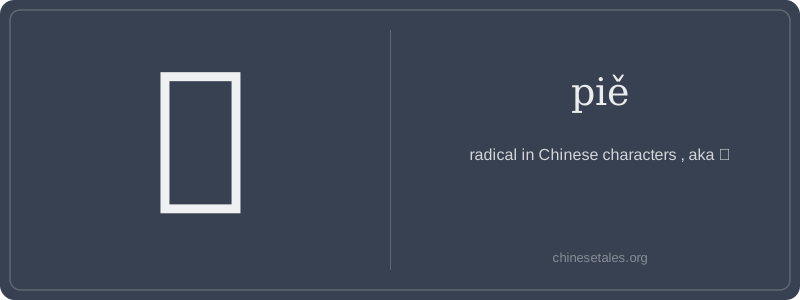
The earliest form of 丿 appears in oracle bone inscriptions (c. 1200 BCE) not as a standalone symbol, but as a stylized variant of the pictograph for 'branch' or 'dividing line' — a simple, unbroken slash carved into bone or turtle shell. Unlike complex ideograms, this stroke was likely a pragmatic mark: a quick, efficient way to indicate direction, separation, or even the falling motion of a scythe or feather. Over centuries, bronze script refined it into a smooth, tapered line; seal script standardized its slight curve and upward hook at the start; and by regular script, it had crystallized into the clean, left-falling stroke we know today — always one stroke, never two, never connected.
This minimalist stroke gained semantic weight through association: in classical texts like the Shuōwén Jiězì (100 CE), Xu Shen classified 丿 as a 'symbolic indicator' (指事 zǐshì) — one of the six character formation principles — denoting 'a line indicating departure or divergence'. It never stood for a thing, but for an action: to cast off, to deflect, to veer. Its visual simplicity mirrors Daoist ideals of effortless action (wúwéi): maximum meaning conveyed with minimum stroke. Even Confucius, in the Analects, used stroke-based metaphors for moral clarity — and 丿, in its stark singularity, became the calligraphic embodiment of decisive, unambiguous intent.
丿 (piě) isn’t a word you’ll use in conversation — it’s a radical, the foundational stroke that shapes meaning and structure across hundreds of characters. Visually, it’s just one graceful, left-falling stroke: like a swift brushstroke sweeping down and left, as if flicking away dust or drawing the tail of a bird in flight. In Chinese, it carries no independent lexical meaning — no dictionary definition, no standalone pronunciation in speech — yet it’s indispensable: it’s the '撇' (piě) in the term for 'left-falling stroke', and the very name of the radical itself.
Grammatically, 丿 never appears alone in writing — you’ll only encounter it as part of larger characters like 人 (rén, person), 入 (rù, to enter), or 九 (jiǔ, nine). It functions like a visual grammar rule: its presence signals directionality, motion downward-left, or sometimes separation (as in 乏 — fá, fatigue — where 丿 sits atop 之, suggesting depletion ‘flicked away’). Learners often mistakenly treat it as a character with meaning or try to pronounce it outside context — but it has no HSK level because it’s not a word; it’s a building block, like an English letter’s shape without phonemic value.
Culturally, 丿 embodies the elegance of Chinese calligraphy’s 'five basic strokes'. Mistaking it for a dot (丶) or a horizontal (一) is common among beginners — but its slant and single-stroke purity make it distinct. Calligraphers revere it as the 'whisper stroke': subtle, decisive, and impossible to correct once ink hits paper. Its silence in speech contrasts with its loud visual authority — a quiet master behind the scenes of every written Chinese sentence.