乀
Character Story & Explanation
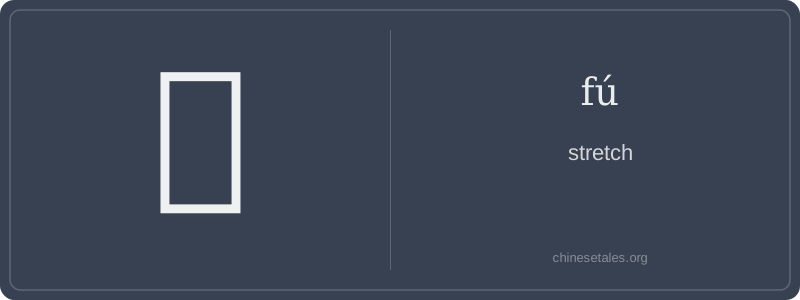
Trace back to oracle bone script (c. 1200 BCE), and you’ll find no pictograph for 乀 — because it didn’t exist as an independent character then. It emerged much later, during the Han dynasty, as scribes and lexicographers began systematically analyzing script structure. The form 乀 crystallized from the cursive, flowing endpoint of right-falling strokes in clerical script — a graceful, unbroken descent that scribes described as ‘fu’ (to stretch out, extend), echoing archery terms where ‘fú’ meant drawing a bowstring taut and releasing it outward. Visually, it’s the minimalist distillation of that kinetic arc: one smooth, unbroken line bending gently rightward — no hook, no dot, no lift.
This ‘stretch’ wasn’t abstract: in classical texts like the *Shuōwén Jiězì* (121 CE), Xu Shen didn’t list 乀 as a standalone character, but his stroke taxonomy implied its function. By the Tang dynasty, calligraphers like Zhang Huaiguan referenced such directional strokes in treatises on brush energy (*qì yùn*), linking 乀 to the concept of *liú* (flow) — the uninterrupted momentum vital to expressive writing. Its shape mirrors how qi (vital energy) moves: not rigidly linear, but yielding yet purposeful, like water stretching across a stone. Even today, when a master corrects a student’s 人 by saying ‘add the fú at the end’, they’re invoking centuries of embodied philosophy — where a single flick of the wrist carries intention, breath, and cultural memory.
Let’s be honest: 乀 isn’t a character you’ll use to order dumplings or ask for directions — it’s not even in the HSK. But that’s exactly why it’s fascinating. In Chinese, 乀 is a *stroke name*, not a word — it’s the official term for the ‘downward-right stroke’ (like the tail of 人 or the final flick in 永). Native speakers don’t say ‘fú’ in daily speech; they say it only when teaching calligraphy, dissecting characters, or naming strokes in dictionaries. Its meaning ‘stretch’ reflects how the brush moves: smoothly extending outward and downward, embodying control, release, and directionality — values deeply embedded in Chinese aesthetics.
Grammatically, 乀 never stands alone as a lexical item. You won’t find it in sentences as a verb or noun — it’s purely metalinguistic. If a learner tries to write ‘I stretch my arms’ using 乀 (e.g., *wǒ 乀 shǒu*), it’s a red flag: that’s not Chinese grammar — it’s mistaking a technical label for a functional word. Instead, real verbs like 伸 (shēn) or 展 (zhǎn) do the work. 乀 appears only inside compound stroke names like ‘piě diǎn 乀’ (the ‘slash-dot-stretch’ sequence) or in pedagogical contexts like ‘yǒng zì bā fǎ’ (the Eight Principles of Yong).
Culturally, 乀 reveals how Chinese treats writing as embodied movement — not just symbols on paper, but traces of the body’s motion. Learners often mispronounce it as ‘fù’ (with fourth tone) due to confusion with similar-sounding words, but it’s strictly fú (second tone). And crucially: it has *zero strokes* in modern stroke-counting systems — yes, really! It’s classified as a ‘non-stroke’ component, a ghostly descriptor of motion rather than a physical mark. That paradox — a named thing with no material presence — is pure classical Chinese conceptual elegance.