乂
Character Story & Explanation
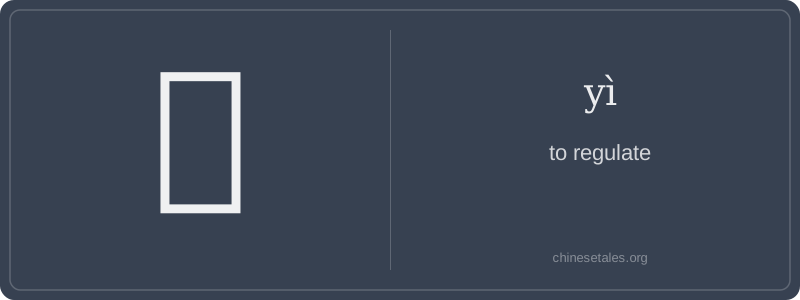
Carved onto oracle bones over 3,000 years ago, 乂 began as a symmetrical X-shaped glyph — two crossed lines representing intersecting forces or paths, like crossroads where decisions shape destiny. Over time, during the bronze script era, the strokes simplified and tilted: the top-right stroke became a clean falling slash (丿), and the bottom-left evolved into a rising捺 (㇏), forming today’s elegant, balanced two-stroke character. This evolution wasn’t random — each stroke retained the original idea of crossing, convergence, and decisive intervention.
By the Warring States period, 乂 appeared in texts like the *Zuo Zhuan*, describing rulers who ‘乂民’ (yì mín) — ‘regulated the people’ — not by coercion, but by reestablishing ritual norms and seasonal rhythms. Its visual duality (two strokes crossing) mirrors its semantic duality: both cutting away disorder *and* weaving harmony. In the *Shuōwén Jiězì* (121 CE), Xu Shen defined it as ‘shān yě’ (to cut down, to prune), linking its form to agricultural regulation — a vivid image of the ruler as a careful gardener tending the state.
乂 (yì) is a quiet powerhouse — just two strokes, yet it carries the weight of cosmic order. Its core meaning is 'to regulate', 'to govern', or 'to bring into harmony', evoking the ancient ideal of restoring balance after chaos. Think of it not as bureaucratic control, but as the gentle, precise trimming of overgrown branches so a tree can thrive: deliberate, skilled, and restorative. In classical Chinese, it’s often used transitively with abstract objects — like regulating rites (礼), virtue (德), or the realm (天下) — and almost always appears in formal, literary contexts, never in casual speech.
Grammatically, 乂 functions as a verb, usually in compound verbs or passive constructions. You won’t hear it alone in modern conversation — it’s strictly literary or archaic. For example, in the phrase ‘乂安’ (yì ān), it pairs with ‘an’ (peace) to mean ‘governed and tranquil’ — a hallmark phrase in imperial edicts. Learners sometimes misread it as a variant of 义 (yì, ‘righteousness’) or mistake its stroke order, writing the捺 (nà) before the丿 instead of after — a subtle error that breaks its symbolic symmetry.
Culturally, 乂 embodies Confucian and Daoist ideals of harmonious governance — not through force, but through timely, balanced intervention. It’s rarely used today outside historical texts, calligraphy, or names (e.g., the scholar-official name 乂之). A common trap? Assuming it’s interchangeable with 治 (zhì, ‘to govern’) — but while 治 implies active administration, 乂 suggests restoration *after* disruption, carrying a poetic, almost surgical connotation of precision.