乴
Character Story & Explanation
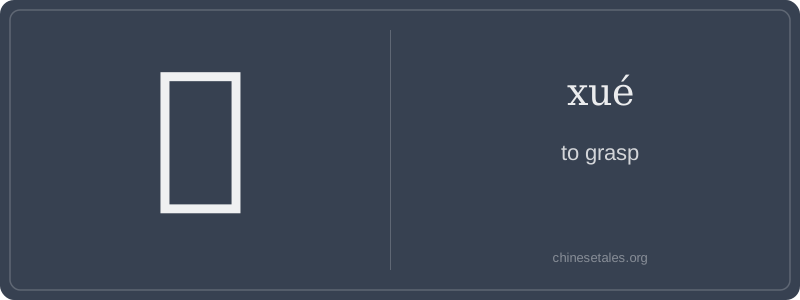
The earliest form of 乴 appears in late Shang oracle bone inscriptions as a vivid pictograph: two curved, converging lines representing bent fingers, beneath a horizontal stroke symbolizing an object being gripped — like a stylized hand closing around a rod or scroll. Over centuries, the ‘fingers’ simplified into two sharp, downward hooks (the top component), while the ‘object’ flattened into a single horizontal line. By the Qin small seal script, the shape stabilized into today’s compact, angular form — no strokes added, no strokes lost: just elegant compression of motion into geometry.
This visual economy mirrors its semantic evolution. In the Shuō Wén Jiě Zì (121 CE), Xu Shen defined 乴 as ‘to hold tightly with fingers’, citing its use in ritual contexts — grasping sacrificial vessels or ancestral tablets with reverent control. Unlike 持 (chí, ‘to hold’), which emphasizes duration, 乴 emphasizes the *initiation* of grip — the decisive curl of the hand. Its rarity in post-Han texts reflects shifting literary tastes, yet it survives in fixed phrases where that moment of intentional seizure remains irreplaceable: think of the Daoist sage ‘grasping the Dao’s essence’ — not holding it, but 乴 it.
Imagine a Tang dynasty scholar in a quiet study, fingers tightly gripping a fragile bamboo slip bearing newly copied poetry — not just holding it, but *securing* it with focused, deliberate pressure. That’s 乴 (xué): not the casual ‘hold’ of 拿 (ná), nor the gentle ‘carry’ of 提 (tí), but a precise, intentional act of grasping — often with fingers curling inward, sometimes implying control, restraint, or even a subtle sense of seizing opportunity. It carries weight, agency, and tactile intention.
Grammatically, 乴 is rare in modern spoken Mandarin and almost never appears alone. You’ll find it only in classical compounds or literary registers — like 乴持 (xué chí), meaning ‘to firmly grasp and maintain’, or 乴取 (xué qǔ), ‘to seize and obtain’. It never takes aspect markers (了, 过) or reduplication like common verbs do. Learners mistakenly try to substitute it for 拿 or 抓 — but doing so sounds archaic, poetic, or outright unnatural in daily speech. Think of it as Chinese’s ‘Shakespearean grip’ — real, meaningful, but reserved for scrolls, metaphors, and solemn oaths.
Culturally, 乴 echoes ancient values of mindful control: not brute force, but calibrated, purposeful action — like a calligrapher’s grip on the brush before the first stroke. Mistake it for 挟 (xié, ‘to coerce’) or 握 (wò, ‘to clasp’), and you risk misrepresenting intent: 乴 implies precision and volition; 挟 suggests coercion; 握 is neutral and physical. Its near-total absence from HSK isn’t oversight — it’s linguistic archaeology waiting for your next classical poem.