乸
Character Story & Explanation
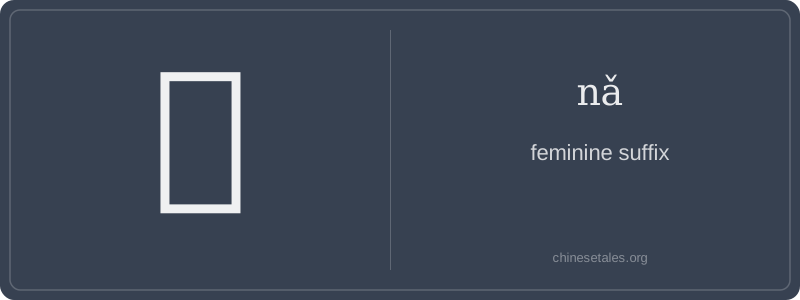
The character 乸 has no oracle bone or bronze script ancestry — it’s a late, ingenious Cantonese invention, likely emerging in the Ming–Qing period as a phonetic-semantic compound. Visually, it combines the radical 丿 (piě, a downward stroke, here acting as a shorthand for ‘person’ or ‘being’) atop the phonetic component 也 (yě), which provides the sound nǎ via regional pronunciation shift (yě → nǎ in Yue dialects). Over centuries, scribes simplified the top stroke and stabilized the form — no complex strokes, just two clean lines: a short slash and a curved hook. Its minimalism is deliberate: designed for speed in handwritten market ledgers and folk notes.
This character was born from necessity, not classics — no Confucian texts cite it, and it appears nowhere in the Kangxi Dictionary. Instead, it thrived in oral culture: Cantonese opera scripts, herbalist labels, and colonial-era Hong Kong signage used 乸 to distinguish livestock sex clearly and efficiently. The visual link to 也 (yě) is ironic: that character originally meant ‘also’ or served as a grammatical particle, but here it’s purely phonetic — a brilliant example of how living language repurposes old forms. Its simplicity masks a deep cultural logic: in agrarian southern China, specifying animal gender wasn’t poetic — it was economic survival.
Here’s the truth no textbook tells you: 乸 isn’t a standard Mandarin character — it’s a Cantonese-specific feminine suffix, pronounced nǎ with a low falling tone. It doesn’t mean ‘female’ by itself; it only functions as a bound morpheme tacked onto nouns (usually animals or kinship terms) to signal female gender — like adding ‘-ess’ to ‘lion’ → ‘lioness’, but far more colloquial and regionally rooted. You’ll never see it in Beijing news broadcasts or HSK textbooks, but in Hong Kong markets, Cantonese novels, or WhatsApp chats, it’s alive and kicking: gāu 乸 (dog-female = female dog), māa 乸 (mother-female = mother, affectionately), or even jī 乸 (chicken-female = hen).
Grammatically, 乸 always appears *after* the noun it modifies — never before, never alone — and it’s almost never used for human females in formal contexts (we say nǚrén 女人, not *rén 乸). Learners often mistakenly treat it like a standalone word or try to use it in Mandarin speech, leading to confused stares. Also, don’t confuse its tone: nǎ (3rd tone) is distinct from nà (4th tone, ‘that’) — mispronouncing it turns your hen into ‘that’.
Culturally, 乸 carries warm, earthy, unpretentious energy — think aunties at dai pai dongs, farmers calling livestock, or grandparents teasing kids. Its absence from formal writing reflects how Cantonese preserves linguistic layers Mandarin streamlined away. A fun quirk: because it’s so tightly bound to spoken Cantonese, many native speakers can’t write it without thinking — and some even mistake it for a variant of 母 (mǔ, ‘mother’), though they share zero etymological roots!