亅
Character Story & Explanation
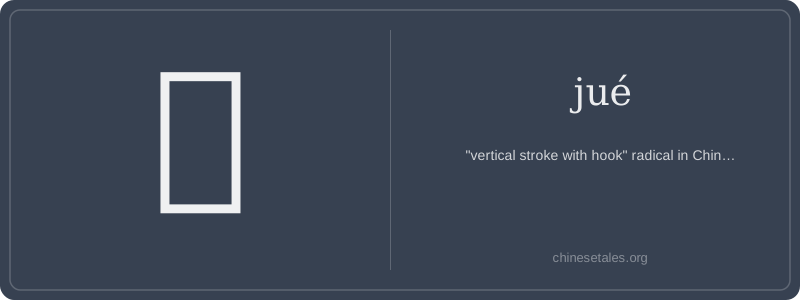
The earliest form of 亅 appears not as a standalone glyph, but as a subtle flourish carved into oracle bone inscriptions around 1200 BCE — a tiny, deliberate hook added to the bottom of vertical strokes in characters like 丁 (dīng) or 于 (yú). Unlike pictographs of animals or tools, 亅 began life as a *stroke modifier*, not a symbol. In bronze script, it hardened into a distinct, angular hook — sometimes exaggerated, sometimes barely visible — always attached to a longer vertical line. By the small seal script era (Qin dynasty), scribes formalized it as an independent radical: a solitary, elegant downward stroke ending in a crisp leftward curl, stripped of any parent character. Its shape was never meant to ‘depict’ anything — it was born from motion: the wrist’s final flick as ink leaves paper.
This radical never carried semantic meaning on its own; its evolution was purely orthographic. Yet classical texts like the Shuōwén Jiězì (100 CE) enshrined it as Radical #5, calling it jué — a word originally meaning ‘to sever’ or ‘to cut off’, reflecting how this hook ‘cuts off’ the vertical stroke with decisive finality. In Song dynasty rubbings and Ming calligraphy manuals, masters stressed that a weak or wobbly 亅 betrayed poor control — making it, ironically, one of the most expressive strokes in Chinese writing, despite having zero lexical content.
Let’s cut to the chase: 亅 isn’t a ‘word’ you’ll ever use in conversation — it’s a ghost of a stroke, a radical with identity crisis. Pronounced jué, it’s the official name for the vertical hook stroke (丨 + ㇆), the kind you see at the end of characters like 小 (xiǎo) or 水 (shuǐ). Think of it less as a character and more as a calligraphic fingerprint — the tiny, decisive flick your brush makes when finishing a downward stroke with a sharp leftward curl. Its ‘meaning’ is purely functional: it signals structural weight and directional closure in handwriting and character analysis.
Grammatically? It doesn’t function at all — no verbs, no nouns, no particles. You’ll never conjugate it or put it in a sentence as a standalone unit. But you *will* encounter it constantly in dictionaries (as Radical #5), stroke-order guides, and handwriting drills. Learners often misread it as a full character and try to use it like one — a classic trap! For example, writing 亅 instead of 了 (le) because both end in a hook? That’s like writing ‘|’ instead of ‘I’ in English — visually suggestive, but meaningless.
Culturally, 亅 embodies Chinese calligraphy’s obsession with intentionality: that single hook isn’t decorative — it’s the moment the brush lifts, carrying finality and balance. Mistake its direction (hook left vs. right) or timing (too early, too late), and the whole character feels unstable. And yes — while native speakers say shù gōu (‘vertical hook’) in teaching contexts, the dictionary radical name remains jué, a fossilized term from ancient lexicography. So don’t hunt for 亅 on menus or subway signs — but do learn to spot it in 少, 手, and 心. It’s the silent architect behind thousands of characters.