亍
Character Story & Explanation
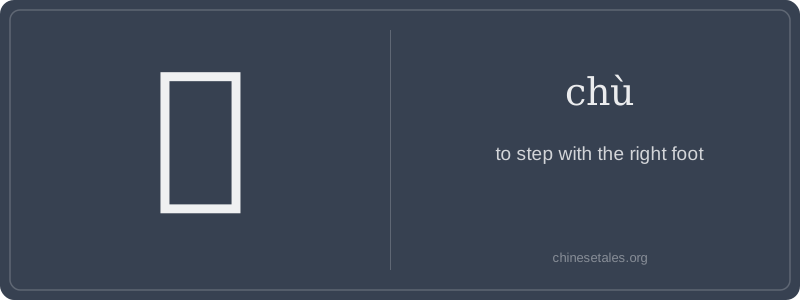
The earliest form of 亍 appears in bronze inscriptions as two parallel horizontal strokes (like 二) with a small, downward-sweeping hook or dot beneath the right stroke — representing the right foot pressing down during a deliberate step. Over time, the hook simplified into a single descending stroke (the third stroke), while the top two strokes stabilized into the clean 二 radical. Unlike most characters that evolved toward abstraction, 亍 grew *more* minimal — shedding detail to emphasize essence: two levels of ground (top stroke = surface, middle = threshold), and one decisive descent (the right foot crossing over). Its three-stroke austerity is no accident — it mirrors the Confucian ideal of 'few words, precise action'.
This character appears in the Shuō Wén Jiě Zì (121 CE), China’s first systematic dictionary, where Xu Shen defines it as 'stepping with the right foot' and links it to ceremonial procession — specifically entering ancestral temples. In Tang dynasty poetry, 亍 occasionally appears in paired form (亍亍) to evoke the slow, reverent walk of a scholar approaching a tomb or shrine. Its visual simplicity belies its loaded function: the two horizontal lines aren’t just 'two' — they’re the boundary between profane and sacred space, and the vertical stroke is the moment of crossing, with intention and reverence.
At first glance, 亍 feels like a linguistic ghost — it’s real, it’s in the dictionary, but you’ll almost never hear it spoken or see it written outside of scholarly contexts or poetic allusions. Its core meaning, 'to step with the right foot', isn’t about walking per se, but about *ritual precision*: in ancient Chinese etiquette, stepping with the right foot first signaled respect, order, and alignment with cosmic harmony — think Confucian propriety encoded in gait. This isn’t a verb you’d use conversationally; it’s a lexical fossil that whispers of a world where every bodily movement carried moral weight.
Grammatically, 亍 is nearly obsolete as a standalone verb. You won’t find it conjugated or used predicatively in modern speech. Instead, it survives almost exclusively in the reduplicative compound 亍亍 (chù chù), mimicking hesitant, measured, or contemplative pacing — often in literary or lyrical contexts ('he paced back and forth' or 'she wandered slowly'). It never appears in compounds with other verbs or particles; it doesn’t take aspect markers (了, 过) or objects. Learners who try to use it like 走 or 行 will sound jarringly archaic — or unintentionally comic.
Culturally, 亍 reveals how deeply Chinese writing embeds kinesthetic philosophy: a single character can encode not just motion, but *which* foot, *why*, and *in what social context*. Modern learners often misread it as a variant of 于 or 干 due to its minimalist shape — but those confusions erase its entire semantic universe. Its rarity isn’t accidental: it’s preserved not for utility, but as a quiet monument to the meticulousness of classical ritual culture — where even stepping was an act of ethics.