亟
Character Story & Explanation
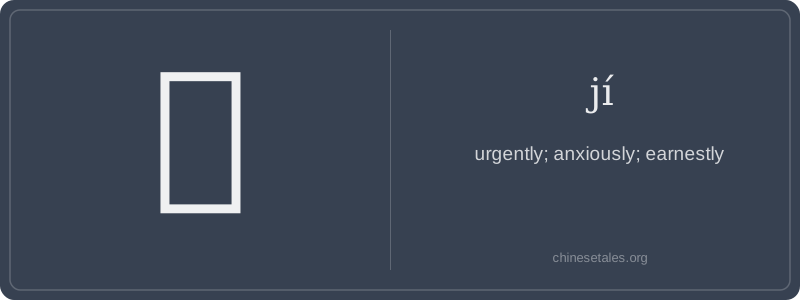
Trace back to oracle bone script (c. 1200 BCE), and 亟 was a vivid scene: two horizontal lines (radical 二) representing heaven and earth, with two stacked 'people' (亼-like shapes) standing between them — one upright, one inverted — symbolizing frantic movement *up and down*, back and forth, across realms. Over centuries, the 'people' simplified into the top 口 and bottom 口 (though now stylized as two mirrored 'mouths'), while the two horizontals hardened into the radical 二 — preserving that cosmic tension between sky and ground, action and consequence.
This visual rhythm — up-down, back-forth — birthed its core meaning: restless, urgent motion. By the Warring States period, it appeared in texts like the *Zuo Zhuan*, describing rulers who 'urgently sought counsel' (亟求谋士). Its duality also gave rise to subtle nuance: 亟 can imply both earnest eagerness ('he earnestly visited three times') and anxious repetition ('she anxiously checked the door again and again'). Even today, its shape whispers motion between boundaries — not just speed, but *intensity of intent*.
Think of 亟 (jí) as Chinese urgency with a heartbeat — not just 'fast', but 'can’t wait another second'. It’s an adverb that pulses with emotional intensity: anxious anticipation, desperate need, or fervent insistence. Unlike common urgency words like 快 (kuài) or 赶紧 (gǎn jǐn), 亟 carries literary weight and classical gravity — you’ll rarely hear it in casual chat, but often spot it in formal writing, news headlines, or policy documents where stakes feel high.
Grammatically, it almost always precedes verbs (e.g., 亟需 jí xū 'urgently needs', 亟待 jí dài 'urgently awaits'), never stands alone, and never modifies nouns directly. A classic learner mistake is trying to say 'urgent thing' as *亟事 — but no! That’s wrong. The correct term is 急事 (jí shì). 亟 only modifies the *action* — the doing, the needing, the waiting — not the thing itself. Think: 'We urgently *require* help' (亟需帮助), not 'We require *urgent* help' (that’s 急需帮助 — different character!).
Culturally, 亟 reflects a Confucian sense of moral immediacy: when duty calls, delay is ethically suspect. You’ll see it in phrases like 亟须改革 (jí xū gǎi gé, 'reform is urgently needed') — implying societal responsibility, not personal impatience. And yes, it *can* be pronounced qì in rare, archaic contexts (like the surname 亟), but for 99.9% of learners, jí is the only pronunciation you’ll ever use — so don’t overcomplicate it!