亠
Character Story & Explanation
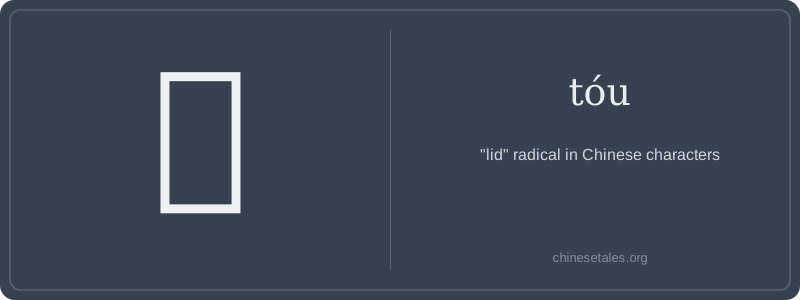
The earliest form of 亠 appears in late Shang oracle bone inscriptions as a simple horizontal line with a short downward stroke beneath its right end — resembling a stylized roof ridge with a supporting rafter. By the Zhou bronze script era, it became more symmetrical: two clean strokes — a flat top and a gentle left-falling diagonal — evoking the peak of a thatched pavilion seen from the front. Over centuries, calligraphers refined it into today’s minimalist pair: the first stroke (héng) is level and firm, the second (piě) descends lightly, like smoke curling from a rooftop incense burner. No curve, no flourish — just authority distilled into two strokes.
This 'roof peak' wasn’t just architectural: in ancient texts like the Shuō Wén Jiě Zì (121 CE), Xu Shen defined 亠 as 'the beginning of things above' — linking it cosmologically to Heaven (天) and ritually to ancestral altars crowned by canopies. Classical poets used characters bearing 亠 — like 亭 (tíng, 'gazebo') or 亮 (liàng, 'bright') — to evoke transcendence or clarity gained through elevation. Visually, its minimalism is deliberate: two strokes are enough to signify 'that which covers and commands', reflecting Confucian ideals where form follows moral function — no excess, only essence.
Think of 亠 (tóu) not as a word you’ll ever say aloud in conversation, but as the architectural 'roof beam' of Chinese characters — like the lintel above a doorway in a Gothic cathedral: invisible as a standalone element, yet essential to the structure’s integrity. It’s not a character you’ll use to order dumplings or ask for directions; it’s a radical — a visual DNA marker that silently signals 'this character has something to do with covering, topping, or being above.' You’ll never write it alone on a menu or text message, but you’ll see it crowning characters like 京 (jīng, 'capital'), 亭 (tíng, 'pavilion'), and 亡 (wáng, 'to perish') — all sharing that sense of enclosure, elevation, or finality.
Grammatically, 亠 doesn’t conjugate, decline, or take particles — because it’s not a word at all. It’s a classifier of meaning, not syntax. Learners sometimes mistakenly try to pronounce it as a syllable in compounds (e.g., misreading 亢 as 'tóu kàng'), but it contributes zero sound — only semantic gravity. Its presence tells your brain: 'Look up. Something is capped, contained, or concluded here.' Unlike English prefixes like 'un-' or 're-', which change meaning predictably, 亠 whispers context: a roof implies shelter, authority, or — in classical usage — the heavens overseeing mortals.
Culturally, 亠 embodies the Chinese philosophical weight of 'the upper realm': heaven (天), ritual propriety (禮), and imperial legitimacy all reside 'above'. Mistaking it for similar strokes (like 冖 or 宀) leads to misreading entire characters — confusing 亢 (kàng, 'high-spirited') with 交 (jiāo, 'to intersect') or missing the ceremonial solemnity in 享 (xiǎng, 'to enjoy offerings'). It’s silent, tiny, and utterly non-negotiable — like the keystone in an arch: remove it, and the whole system collapses.