亶
Character Story & Explanation
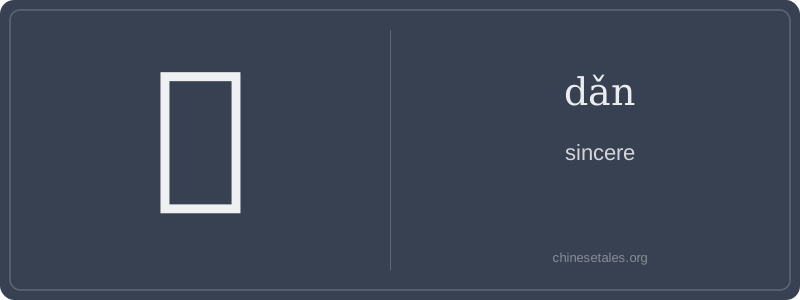
The earliest form of 亶 appears on Western Zhou bronze inscriptions as a stylized vessel (the top 亠 + 冂-like enclosure) holding grains — specifically, a ritual grain container brimming with millet or rice. That full vessel wasn’t just food: it symbolized abundance offered without reservation to ancestors or Heaven. Over centuries, the pictograph simplified: the vessel’s lid became 亠, the sides fused into 冂, and the stacked grains inside evolved into the six horizontal strokes beneath — all 13 strokes representing deliberate, abundant sincerity poured out, not withheld.
This visual logic anchored its meaning: sincerity as tangible, measurable, and sacrificial. In the Book of Documents, King Wen is praised as having ‘亶德’ (dǎn dé) — virtue so authentic it moved Heaven. Later, in Han dynasty commentaries, 亶 was used to mark ‘unquestionable truth’ in legal records. Even today, its shape whispers: sincerity isn’t abstract — it’s full, visible, and offered whole, like grain heaped high in a sacred vessel.
At its heart, 亶 (dǎn) isn’t just ‘sincere’ — it’s sincerity with weight, integrity that’s been tested and proven. Think of a Confucian elder nodding slowly: not just honest, but deeply, unwaveringly genuine — the kind of truth that doesn’t flinch under scrutiny. Unlike common synonyms like 真 (zhēn) or 诚 (chéng), 亶 is literary, almost archaic; you’ll rarely hear it in casual speech, but it appears in classical texts, formal inscriptions, and compound words where gravity matters.
Grammatically, 亶 functions almost exclusively as an adjective — but never alone. It always appears embedded: in two-character compounds (e.g., 亶诚, 亶然), or as part of fixed phrases like 亶父 (Dǎnfù, the revered ancestor of the Zhou dynasty). You won’t say ‘他很亶’ — that’s ungrammatical and jarring to native ears. Instead, it modifies nouns or predicates with quiet authority: 亶然自若 (calmly sincere by nature), 亶厚 (genuinely thick-hearted — i.e., profoundly kind).
Culturally, 亶 reflects how Chinese tradition links sincerity with ancestral virtue and moral constancy — not fleeting emotion. Learners often misread it as ‘dān’ (like 单) or confuse it with 詹 (zhān); both errors erase its solemn resonance. Its rarity outside classical contexts means mistaking it for a typo is common — but once you recognize its seal-script gravitas, you’ll feel the hush before a temple bell rings.