仨
Character Story & Explanation
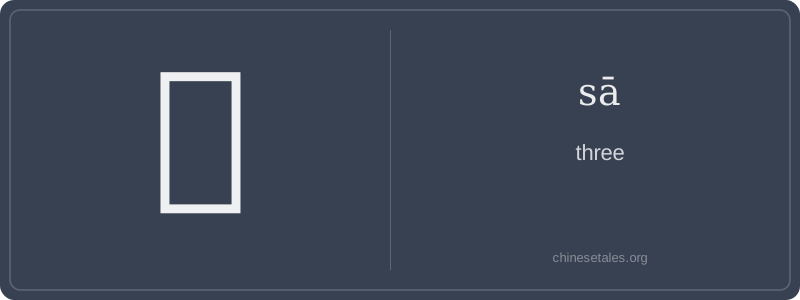
The character 仨 has no ancient oracle bone or bronze script origin — it’s a latecomer, born in the Ming–Qing vernacular period as a phonetic-semantic compound. Its left side 亻(rending ‘person’) is the radical, signaling its human reference; the right side is a simplified, cursive-influenced variant of 三 (sān, ‘three’), reduced from three horizontal strokes to three connected dots or short lines — hence the modern five-stroke form: 亻+ three quick dashes. Visually, it’s a clever visual pun: ‘person’ + ‘three’ fused into one glyph, like handwriting slurring ‘three people’ into a single gesture.
This fusion reflects how spoken Mandarin streamlined counting for people: why say ‘three + classifier + person’ when you can scribble one compact symbol? Though absent from classical texts (which used 三人 sān rén), 仨 appears in Qing dynasty folk novels and Beijing opera scripts as shorthand for intimate, conversational speech. Its shape doesn’t depict an object or action — it’s pure linguistic efficiency made visible: three people, drawn not as individuals, but as a unit — inseparable, familiar, and unmistakably human.
Think of 仨 (sā) as Chinese’s version of the slangy, affectionate ‘three-some’ — but without the baggage. It’s not formal ‘three’ (三 sān), nor poetic ‘triplet’ (三子 sān zǐ); it’s the warm, colloquial, slightly folksy word for ‘three people’, almost always used *only* for humans — like saying ‘the three of us’ or ‘those three guys’. You’ll never say ‘仨 apples’; that’s ungrammatical and instantly marks you as a textbook learner. It’s strictly anthropocentric: 仨人 (sā rén) = ‘three people’, full stop.
Grammatically, 仨 acts like a numeral-classifier hybrid — it replaces both the number and the human classifier 个 (gè). So instead of 三个人 (sān gè rén), you say 仨人 (sā rén). No ‘个’, no ‘三’. Drop either part, and it sounds unnatural or even wrong. It’s also almost exclusively oral and regional — most common in Northern Mandarin (especially Beijing and Hebei dialects), and rare in formal writing, news, or textbooks. Learners often overuse it trying to sound ‘native’, only to confuse listeners expecting standard 三.
Culturally, 仨 carries a cozy, intimate tone — like sharing dumplings at a family table. It implies familiarity, informality, and shared experience. Misusing it (e.g., with objects or in formal emails) is like showing up to a black-tie event in sweatpants: technically clothed, but tonally disastrous. And yes — it’s absent from HSK because it’s too dialectal and too narrow in function to be essential for global learners… yet it’s everywhere in sitcoms, WeChat voice notes, and street-side banter.