仵
Character Story & Explanation
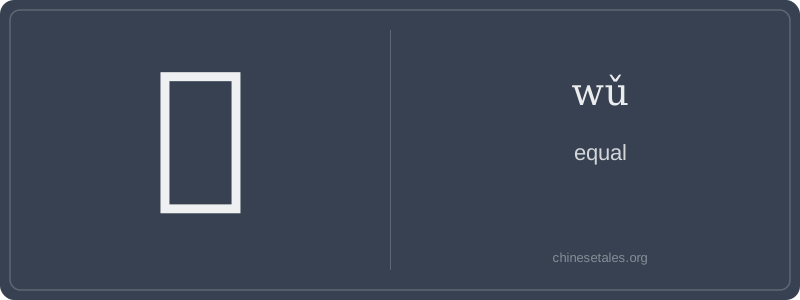
The earliest form of 仵 appears in Warring States bamboo slips as a compound pictograph: left side 亻 (person), right side 吾 (wú, 'I/my'), but stylized with a horizontal stroke across the mouth component (口) — suggesting *two persons asserting shared identity or status*. Over time, the right side simplified from 吾 to 五 (wǔ, 'five'), losing the mouth but keeping the count — possibly hinting at 'five equals', referencing ancient pentadic social groupings. By Han dynasty clerical script, the strokes stabilized into today’s six-stroke form: two for the person radical (亻), then four for the phonetic 五 (wǔ) — a rare case where the phonetic also echoes meaning (five as symbolic of balanced, symmetrical grouping).
This visual logic shaped its meaning: 仵 wasn’t about abstract sameness, but *ritual parity* — two officials performing identical rites, two families exchanging equivalent dowries, or two states signing treaties as peers. The Classic of Rites (Lǐjì) uses 仵 to describe how mourners ‘match’ each other’s grief intensity — not emotionally, but per prescribed degrees. Its decline began in Tang dynasty when 更 (gēng) and 等 (děng) absorbed its functional space, leaving 仵 as a lexical relic — preserved only where precision in status-matching mattered most: forensic investigation (仵作), where the coroner must stand *exactly equal between law and body*, neither above nor below.
Think of 仵 (wǔ) not as a common 'equal' like the mathematical = sign or the English word 'equal', but as the ancient Chinese version of a courtroom gavel — it’s about *status equivalence*, especially in hierarchical, ritual-bound contexts. In classical texts, 仵 never means 'identical' or 'numerically equal'; instead, it signals *parity in rank, duty, or ceremonial standing* — like two ministers bowing at the same angle before the emperor. You’ll almost never see it in modern spoken Mandarin; it’s a fossilized literary term, surviving mostly in historical novels, legal classics, or idioms like 仵作 (wǔ zuò, 'coroner'), where its 'equal' sense subtly implies someone *equally positioned between life and death, law and corpse*.
Grammatically, 仵 is nearly always a verb meaning 'to be equal to (in status/role)' or 'to match (in rank)', and it’s almost exclusively used in formal, archaic constructions — never with measure words, never in casual speech, and never in compounds like 'equal opportunity'. A classic pattern: 'A 与 B 仵' (A yǔ B wǔ) — 'A stands on equal footing with B'. Learners mistakenly try to use it like 等于 (děngyú, 'equals') or 相等 (xiāngděng, 'are equal'), but that’s like using 'henceforth' instead of 'so' — grammatically possible, but jarringly anachronistic.
Culturally, 仵 carries quiet tension: it reflects Confucian insistence that equality isn’t inherent — it’s ritually conferred and context-specific. Misusing it (e.g., saying '我跟你仵' for 'I’m equal to you') sounds either hilariously pompous or dangerously subversive — like declaring yourself peer to the Emperor. And beware: it’s easily misread as 伍 (wǔ, 'squad of five') due to identical pronunciation and similar radical — a tiny stroke difference that swaps hierarchy for military unit.