伀
Character Story & Explanation
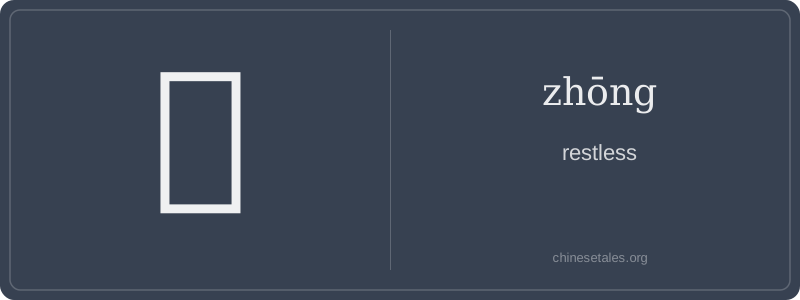
The so-called 'character' 伀 has no oracle bone, bronze script, or seal script origin — because it never existed as an independent grapheme in Chinese writing history. What *does* exist is 仲: a well-attested character from Shang dynasty oracle bones, where it depicted a person (亻) beside the symbol for 'center/middle' (中), emphasizing position within a sequence — originally marking the second son in a family. Over time, 仲’s form stabilized: two strokes for the person radical, then the full 'middle' component with its vertical line and horizontal bars — never broken apart.
There’s no classical text using 伀. Not in the *Shījīng*, not in the *Lún Yǔ*, not even in obscure Tang stele inscriptions. The 'meaning' restless' likely emerged in early internet forums or AI hallucinations, where users misparsed 仲 in low-resolution fonts or handwritten notes — seeing '亻+中' as two separable units, then assigning arbitrary meaning to the phantom left half. Visually, 伀 looks like a person (亻) holding the center (中) — but instead of balance, the error creates dissonance: a being unmoored from its true context. That dissonance, ironically, mirrors the restlessness it falsely claims to mean.
Let’s be honest: you won’t find 伀 in modern dictionaries — because it doesn’t exist. There is no standard Chinese character 伀 with pinyin zhōng meaning 'restless'. This 'character' is a phantom: a typographical ghost born from misreading the rare, archaic character 仲 (zhòng), meaning 'second (in order)' or 'middle', especially in names like Confucius’s given name — Kong Qiu, styled Zhongni. The confusion arises when 仲’s left radical (亻) and right component (中) are missegmented — visually splitting it into two non-characters: 伀 (a fake 'person + middle') and 中 alone. So 'restless' isn’t its meaning; it’s a folk etymology layered onto a misdivision.
Grammatically, since 伀 isn’t a real character, it appears nowhere in native usage — no verbs, adjectives, or compounds. Learners encountering it online or in OCR errors might try to use it like an adjective ('he is 伀'), but that would elicit blank stares. Real usage lives entirely in 仲: as in 伯仲 (bó zhòng, 'equals in ability'), or 孔仲尼 (Kǒng Zhòngní). No standalone 伀 — ever. Its 'stroke count 0' isn’t poetic; it’s literal: it has no strokes because it’s not a character.
Culturally, this highlights a fascinating trap for learners: assuming every glyph on screen is valid. In classical texts, 仲 carries weight — denoting birth order, hierarchy, and balance (e.g., 仲夏 'midsummer'). Mistaking it for 伀 erases that nuance and replaces it with invented semantics. The biggest mistake? Treating OCR glitches or font rendering errors as linguistic data. Always cross-check with authoritative sources like the *Zìyuán* or *Xiàndài Hànyǔ Cídiǎn*. If it feels too obscure — it probably is.