伈
Character Story & Explanation
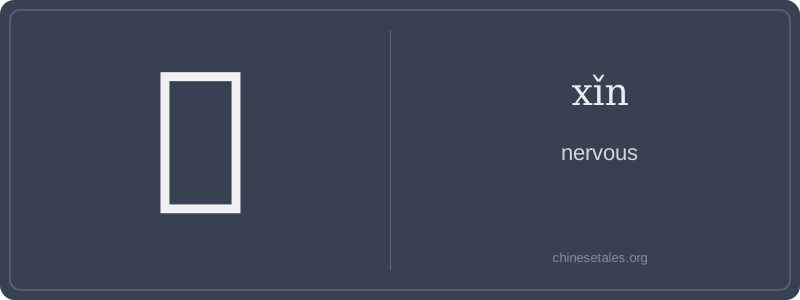
The earliest trace of 伈 appears not in oracle bones, but in seal script (c. 3rd century BCE), where it was written as two small, asymmetrical 'people' radicals (亻) stacked vertically — a visual echo of two figures shrinking side-by-side. Over centuries, the top 亻 simplified into a single slanted stroke, while the lower 亻 retained its two-stroke structure (撇 + 捺), resulting in today’s minimalist 4-stroke form: 亻+ 尔 (but not the character 尔 — just a stylized echo). The evolution wasn’t phonetic simplification; it was graphic compression — distilling human vulnerability into minimal ink.
This visual reduction mirrors its semantic journey: from depicting actual crouching servants (in early commentaries on the Book of Rites) to symbolizing psychological submission. By the Tang dynasty, poets like Han Yu used 伈 in parallel constructions (e.g., 伈伈而畏) to evoke moral timidity before virtue — not cowardice, but awe-struck humility. Its shape — small, off-balance, leaning inward — still whispers that ancient posture: head bowed, limbs drawn in, breath held tight.
At first glance, 伈 looks like a tiny, trembling creature — and that’s exactly the feeling it carries. Its core meaning is 'nervous', 'timid', or 'apprehensive', but it’s not the everyday jitters you’d describe with 紧张 (jǐnzhāng); 伈 is literary, archaic, and almost poetic in its fragility. It conveys a visceral, physical unease — like shoulders hunching, breath catching, eyes darting — rooted in deep-seated fear or deference. You’ll rarely hear it in spoken Mandarin; it lives in classical texts, idioms, and carefully crafted prose.
Grammatically, 伈 never stands alone as a verb or adjective in modern usage. Instead, it appears almost exclusively in reduplicated form: 伈伈 (xǐn xǐn), where repetition intensifies the timidity — think 'shrinkingly shy' or 'quiveringly fearful'. It can also pair with other characters like 伈伈慄慄 (xǐn xǐn lì lì), a four-character idiom meaning 'trembling with dread'. Learners often mistakenly treat 伈 as a standalone word ('I feel xǐn'), but it’s grammatically inert without reduplication or coupling — a classic 'ink-and-brush-only' character.
Culturally, 伈 evokes Confucian restraint: the nervous deference of a junior official before a magistrate, or a scholar bowing low before ancestral tablets. Its rarity today makes it a linguistic fossil — charming but functionally obsolete outside literary imitation or calligraphic flourish. A common mistake? Pronouncing it as xīn (like 心) — but the tone is third, not first, and the meaning has zero relation to 'heart'. It’s not about emotion *in* the heart — it’s about the body *folding* under pressure.