伉
Character Story & Explanation
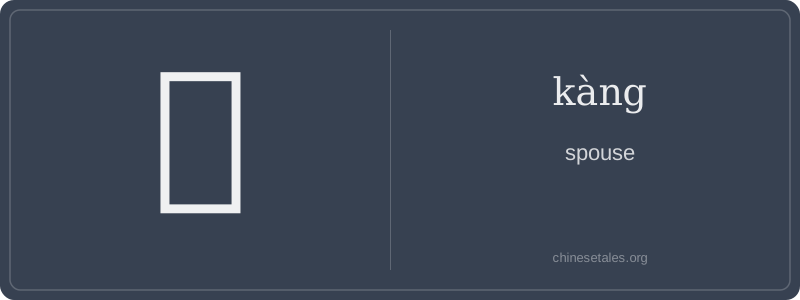
The earliest form of 伉 appears in Warring States bamboo slips, where it was written with the 亻 (person) radical on the left and a simplified version of 夊 (suī) — a pictograph of a foot stepping forward — on the right. Over time, 夊 evolved into 广 (guǎng), but crucially, the top stroke bent downward to become the distinctive 'roof-like' shape we see today (the horizontal stroke with downward hook). This wasn’t arbitrary: the original 亻+夊 suggested 'a person moving forward together' — evoking partnership and coordinated action, not just cohabitation.
By the Han dynasty, 伉 had crystallized in meaning through texts like the Rites of Zhou, where 伉俪 described noble couples fulfilling ritual roles in tandem — husband offering wine, wife presenting silk, each movement mirrored and balanced. The visual balance of the character (two symmetrical components: 亻 and the compact 广-like right side) reinforced this idea of parity. Unlike modern terms emphasizing love or romance, 伉 always implied solemn, reciprocal duty — so much so that in Ming-Qing fiction, calling someone ‘伉’ without 俪 was considered incomplete, almost impolite, like introducing half a pair of chopsticks.
At first glance, 伉 (kàng) feels like a quiet, formal word — it means 'spouse', but not the everyday kind you’d use with friends. Think of it as the Mandarin equivalent of saying 'consort' or 'life partner' in a legal document or classical poem: dignified, balanced, and slightly elevated. It’s almost never used alone; you’ll nearly always see it doubled as 伉俪 (kàng lì), meaning 'a married couple' — and even then, it’s reserved for formal contexts like wedding invitations, news reports about celebrities, or literature.
Grammatically, 伉 is strictly a literary character — it doesn’t appear in spoken Mandarin as a standalone noun (you’d say 配偶 or 爱人 instead). It only functions within compound words, most commonly with its partner character 俪 (lì), forming the elegant, symmetrical term 伉俪. Notice how both characters share the same radical (亻) and similar stroke rhythm — that symmetry reflects the Confucian ideal of marital harmony: two equal, complementary people standing side by side. You’ll never hear someone say '我丈夫是伉' — that would sound bizarre and ungrammatical.
Culturally, 伉 carries an aura of dignity and mutual respect — no romantic fluff, no slangy affection. Learners often mistakenly assume it’s a general synonym for 'husband' or 'wife', but it’s actually gender-neutral and inherently relational: it only makes sense when referring to *both* partners *as a unit*. A common trap? Confusing it with 坑 (kēng, 'pit') — same tone, similar sound, wildly different meaning! And remember: while 伉 appears in compounds, it never takes measure words, possessives, or plural markers — its grammar is fossilized in elegance.