伲
Character Story & Explanation
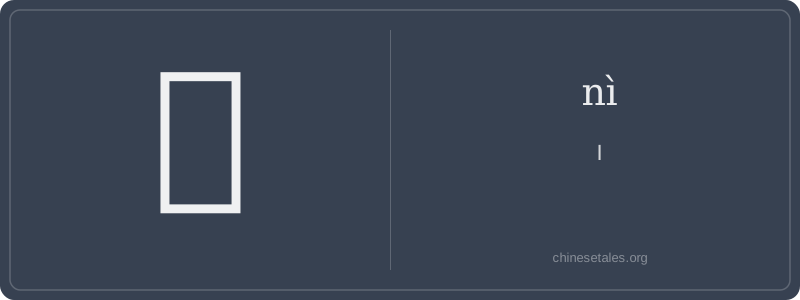
The character 伲 didn’t begin as a pictograph at all—it’s a late, phonetic creation from the Qing dynasty onward, born not of oracle bones but of dialect transcription needs. Its left side 亻 (rén bàng) is the standard ‘person’ radical, anchoring it semantically as a pronoun. The right side 尼 (ní) was borrowed purely for its sound—not its meaning (‘Buddhist nun’)—to approximate the Wu pronunciation /ni/ or /nɪ/. Visually, it’s a deliberate fusion: two strokes for the person radical (撇 + 竖), then four more for 尼 (尸 + 丿 + 一 + 丨), totaling seven clean, balanced strokes—like someone quickly jotting ‘me’ on a noodle shop order pad.
Unlike ancient characters carved in bronze, 伲 emerged from daily speech pressed into print—first in late imperial folk plays, then in early 20th-century Shanghai opera libretti and Wu-language novels. You won’t find it in the *Shuōwén Jiězì*, but you’ll hear it in a 1930s Shanghai film where a street vendor shouts ‘伲今朝卖得老好!’ (Nì jīncháo mài de lǎo hǎo!). Its shape doesn’t depict a person—it *sounds* like one. That right-side 尼 isn’t a nun; it’s a phonetic stand-in, a clever orthographic wink saying, ‘Say it like this—and you’re in the club.’
伲 (nì) isn’t a standard Mandarin pronoun—it’s a warm, earthy ‘I’ from the Wu Chinese dialect family, especially beloved in Shanghainese and Suzhounese speech. Think of it as the linguistic equivalent of slipping off your shoes and padding into a cozy, steamed-bun-scented kitchen: intimate, regional, and utterly unbothered by Beijing’s grammar rules. It carries zero formality—no ‘I’ here wears a suit or signs contracts; this is ‘I’ as neighbor, friend, or grandma leaning over the balcony railing to call you down for dumplings.
Grammatically, 伲 stands alone like a first-person subject pronoun—no particles needed—but it *never* appears in formal writing, textbooks, or official speech. Learners sometimes try to swap it for 我 (wǒ) in Mandarin sentences (‘伲 shì xuéshēng’), which instantly sounds like a cartoon character doing a bad Shanghai accent. Nope: 伲 only lives inside Wu dialect syntax—so ‘伲去哉’ (nì qù zāi) means ‘I’m off now’, with the Wu-specific particle 哉 (zāi) completing the phrase. Drop the dialect context, and 伲 vanishes like steam from a xiaolongbao.
Culturally, 伲 is a quiet act of resistance—a spoken fingerprint of local identity in a nation that prizes Putonghua unity. Young Shanghainese use it online with playful pride (#伲话最嗲), while elders deploy it like a secret handshake. Mistake? Assuming it’s ‘just another word for I’. It’s not—it’s a vowel-rich, two-syllable whisper of belonging, carrying the weight of canals, teahouses, and generations who said ‘伲’ while folding wontons at midnight.