伹
Character Story & Explanation
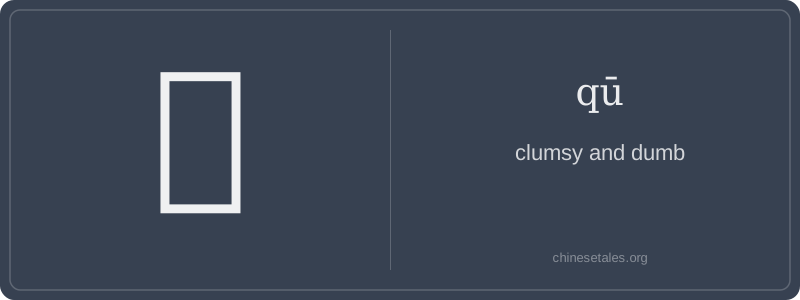
The character 伹 does not appear in oracle bone or bronze inscriptions—it’s a late creation, first documented in the Yupian (c. 543 CE), a Southern Dynasties dictionary compiling rare and variant forms. Its form merges the radical 亻 (rén, 'person') with 屈 (qū, 'to bend, yield'), visually suggesting 'a person who bends awkwardly'—not in submission, but in physical or mental contortion. The left side anchors it as human; the right side, borrowed phonetically from 屈, gives both sound and metaphorical weight: bending too far, folding the wrong way, losing balance.
This visual pun deepened in Song-era literati writing, where 伹 appeared in critiques of overly rigid scholarship—e.g., '其论迂而伹' (his argument is pedantic and obtuse)—implying intellectual inflexibility masquerading as rigor. By the Qing dynasty, it had crystallized into a literary term for congenital, non-malicious ineptitude, distinct from moral failure or laziness. Unlike 屈, which can imply noble endurance, 伹 conveys harmless, almost charming incapacity—like a scholar trying to ride a donkey backward while reciting poetry.
Imagine a bustling Ming-dynasty workshop where a young apprentice named Qū keeps dropping porcelain bowls, tripping over his own robe hem, and misreading blueprints—so often that the master craftsman sighs, 'Qū yòu bǎ túzhǐ kàn chā le!' (Qū has misread the blueprint again!). That’s 伹 in action: not just 'clumsy' or 'dumb' in a harsh sense, but a gentle, almost affectionate label for someone endearingly inept—not maliciously foolish, but harmlessly out-of-sync with reality.
Grammatically, 伹 is almost never used alone. It appears only in fixed, classical-style compounds like 伹拙 (qū zhuō) or 伹钝 (qū dùn), always as the first syllable, and always modifying nouns or verbs to intensify awkwardness or mental sluggishness. You’ll never see '他很伹'—that’s ungrammatical. Instead, it’s embedded: '这招式用得甚是伹拙' (This technique was executed with remarkable clumsiness). Learners often mistakenly treat it like an adjective they can slot in freely—but 伹 is a fossilized literary morpheme, not a living word.
Culturally, 伹 carries a quiet Confucian undertone: it describes incompetence rooted in lack of cultivation—not stupidity, but underdeveloped refinement. Mistaking it for modern slang ('dumb') misses its poetic humility; confusing it with colloquial terms like 笨 (bèn) or 傻 (shǎ) risks sounding archaic or sarcastically lofty. And crucially: it’s *not* used in speech today—it survives only in historical novels, satire, or wry self-deprecation among scholars. If your textbook says 'common usage', gently close it.