伻
Character Story & Explanation
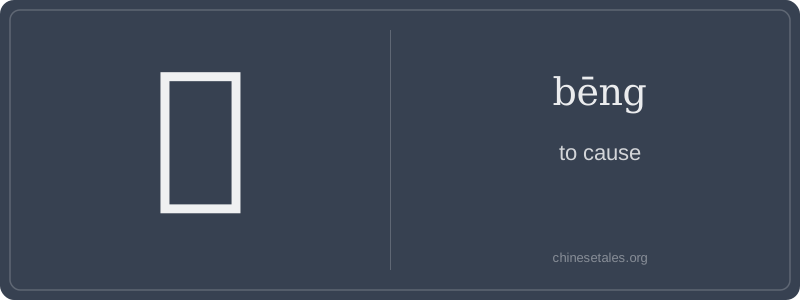
The earliest form of 伻 appears in bronze inscriptions from the late Western Zhou period (c. 9th century BCE). It was originally written as 亻+丙 — a human radical (亻) beside 丙 (bǐng), the third of the Ten Heavenly Stems. Crucially, 丙 itself began as a pictograph of a ceremonial torch or beacon — a vertical line with two horizontal strokes symbolizing flames — representing illumination, direction, and authoritative signal. When combined with 亻, the character visually conveyed 'a person dispatched with a directive flame': not just sending, but sending *with purpose*, *under mandate*. Over centuries, 丙 simplified, losing its flame-like flourishes, and the whole character stabilized into today’s 伻 — compact, upright, and quietly commanding.
This semantic core held firm across millennia: in the Book of Documents (Shūjīng), 伻 appears in the phrase '伻来以图' — 'send [envoys] to deliberate plans' — underscoring its role in statecraft and delegation. Confucian commentators noted that 伻 implied moral responsibility: one who 伻-s must ensure the mission aligns with ritual propriety (lǐ). Even in modern usage, its shape — slender, vertical, unadorned — mirrors its function: no extra syllables, no wasted motion — pure, authorized causation.
Think of 伻 (bēng) as the Chinese equivalent of the Latin prefix 'caus-' — like in 'cause', 'causal', or even the legal term 'causation'. It’s not a standalone word you’ll hear in daily chatter, but a literary, almost bureaucratic verb meaning 'to cause' or 'to send forth to effect something'. Unlike English 'cause', which can be transitive ('She caused the accident'), 伻 is almost always used in classical or formal written contexts — think imperial edicts, ancient contracts, or modern legal documents — and nearly always takes an agent (who causes) and a purpose (what is caused). You’ll see it in phrases like '伻人往告' (send someone to inform), where 伻 governs the action of dispatching with intent.
Grammatically, 伻 functions like a monosyllabic causative verb — similar to how English uses 'make' or 'have' — but it’s never used alone. It demands a complement: usually a noun (the person sent) plus a verb (the task). Learners often mistakenly treat it like a synonym for 让 (ràng) or 使 (shǐ), but those are neutral; 伻 carries weight — it implies authority, delegation, and formality. You’d use 伻 in a Ming-dynasty memorial, not a WeChat message.
Culturally, 伻 is a linguistic fossil — preserved in classical texts and revived only in hyper-formal registers, like diplomatic notes or historical dramas. A common mistake is overusing it in spoken Chinese or confusing its tone: bēng (first tone), not běng (third tone, which means 'stiff'). Its rarity makes it a telltale sign of advanced literary competence — spotting 伻 in a text is like finding a watermark on antique paper: subtle, intentional, and quietly prestigious.