伽
Character Story & Explanation
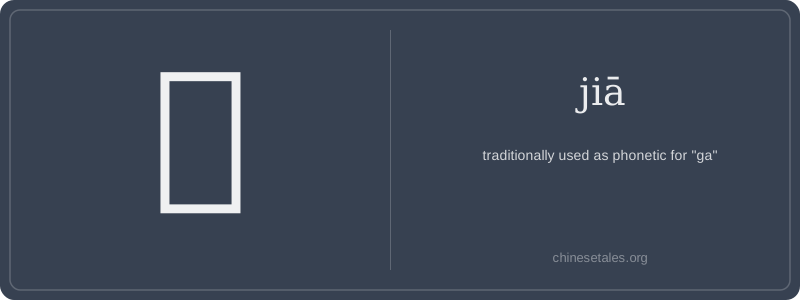
伽 has no pictographic origin — it’s a later phonetic compound, born not from nature or ritual, but from necessity. Its earliest attested form appears in Han dynasty bamboo slips as a simplified variant of 加 (jiā, ‘to add’), sharing the same 亻 (person) radical and 可 (kě) phonetic component. But while 加 evolved to mean ‘add’, 伽 was deliberately repurposed: scribes kept its shape but severed its native meaning, reserving it solely for foreign sounds. Visually, it’s clean and minimal — two strokes for the person radical (亻), then five more forming 可 without the top horizontal stroke of 加, making it slightly leaner and more delicate.
This deliberate semantic divorce began in the Eastern Han, when translators needed characters that sounded like Sanskrit syllables but wouldn’t mislead readers with unintended meanings. Classical texts like the *Mahāprajñāpāramitā Śāstra* (c. 402 CE) use 伽 consistently in transliterations like 伽陀 (qié tuó, ‘gāthā’, a verse form). Over centuries, its visual stability — unlike many transliteration characters that drifted or fell out of use — cemented it as the go-to ‘ga’ sound, especially before back vowels. Its quiet persistence reflects how deeply translation shaped Chinese writing itself.
Imagine you’re browsing a dusty antique shop in Xi’an and spot a faded Tang-dynasty Buddhist sutra scroll. There, nestled beside Sanskrit transliterations, is the character 伽 — not as a word with independent meaning, but as part of a sacred phonetic team: 伽 (jiā) + 摩 (mó) = 伽摩 (jiā mó), transcribing the Sanskrit 'Kāma' (desire). That’s 伽’s true role: a quiet, seven-stroke linguistic placeholder — a ‘sound-only’ servant borrowed over 1,600 years ago to help Chinese monks pronounce Indian sacred terms. It carries no native Chinese semantics; it’s pure phonetic scaffolding.
Grammatically, 伽 appears almost exclusively in fixed transliterations — never alone, rarely modified. You’ll see it in 佛陀 (fó tuó, Buddha), 伽蓝 (qié lán, monastery), or 伽倻琴 (jiā yē qín, Korean gayageum). Note the twist: though usually jiā, it’s pronounced qié before certain vowels (like in 伽蓝) — a relic of Middle Chinese phonology that still trips up learners who assume tone consistency. Mistake? Writing 伽 when you mean 加 (jiā, ‘to add’) — a visually similar but semantically explosive error.
Culturally, 伽 is a silent witness to China’s intellectual openness: it entered via Silk Road translation bureaus where scholars like Kumārajīva treated Sanskrit sounds like precious gems — assigning specific characters not for meaning, but for acoustic fidelity. Modern learners rarely need it outside Buddhist or musical terminology, but spotting it is like finding a Sanskrit fingerprint on Chinese script — proof that language can be a vessel, not just a mirror.