伾
Character Story & Explanation
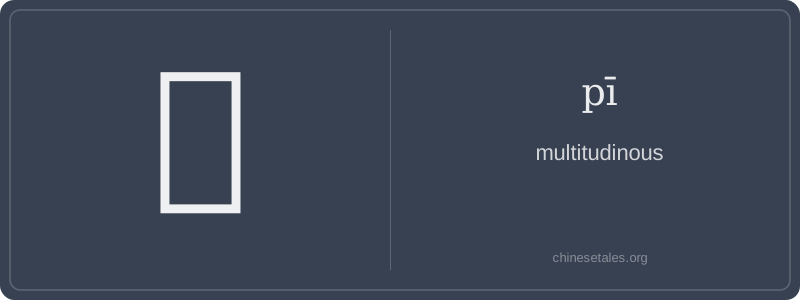
Oracle bone inscriptions show no direct precursor for 伾, but its bronze script ancestor likely fused 亻 (rén, ‘person’) with 否 (fǒu, ‘not’ — later stylized into the lower part). Wait — that’s misleading! The bottom isn’t 否; it’s an ancient variant of 不 (bù), which originally depicted a sprout pushing through soil — symbolizing emergence and proliferation. Over centuries, that sprout shape simplified into the modern 丕-like base, while the left-side 亻 anchored it to human-scale abundance. So visually: ‘person + rising, multiplying force’ = a crowd swelling organically.
By the Han dynasty, 伾 appeared in texts like the *Shuōwén Jiězì*, defined as ‘massive and numerous’ (‘wēi ér duō yě’), applied to rivers, armies, and ceremonial processions — always implying awe-inspiring scale *in motion*. Its most famous usage is in the compound 伾伾 (pī pī), echoing in Tang poetry to describe thunderous hooves or cascading waterfalls. Crucially, its visual form — slender 亻 beside a bold, upward-thrusting base — mirrors its meaning: individual humans dissolving into a powerful, unified swell.
伾 (pī) is a rare, elegant ghost of classical Chinese — it doesn’t shout; it *swarms*. Its core meaning 'multitudinous' isn’t about sheer quantity like 多 (duō), but about dense, dynamic, almost overwhelming abundance — think of a river swelling with tributaries, or crowds surging through ancient city gates. It carries a literary gravity: you’ll almost never hear it in casual speech or see it on subway ads. Instead, it lives in poetic compounds and classical allusions, where it evokes visual richness and energetic fullness.
Grammatically, 伾 functions almost exclusively as a descriptive morpheme within disyllabic adjectives — never alone, never as a verb or noun. You won’t say *‘this crowd is 伾’*; you’ll say *‘the crowd is 伾伾’* (pī pī), doubling it for emphasis and rhythm — a classic reduplication pattern for intensifying adjectival meaning. Learners often mistakenly treat it like a standalone adjective (e.g., *‘very 伾’*), but that’s ungrammatical — it’s a fossilized root that only breathes when paired.
Culturally, 伾 is a quiet testament to how Chinese preserves semantic nuance across millennia: its ‘crowded density’ feels tactile, almost kinetic — not abstract or statistical. A common trap? Confusing it with 坯 (pī, ‘unfired clay brick’) or 丕 (pī, ‘grand, great’). Both share the sound and stroke count, but 伾 alone carries this specific sense of teeming, organic multitude — like watching thousands of fireflies rise at once, not just ‘many’, but *alive with multiplicity*.