佐
Character Story & Explanation
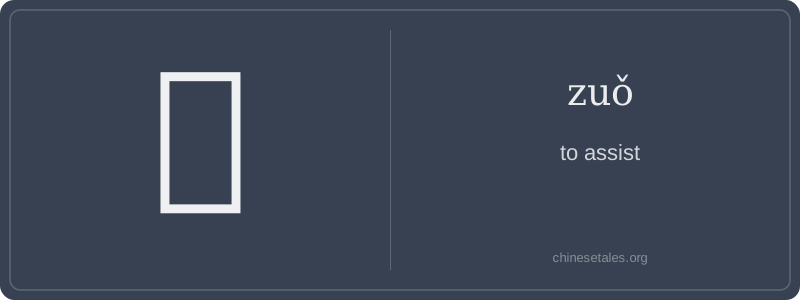
The earliest form of 佐 appears in Western Zhou bronze inscriptions as a person (亻) standing beside a simplified depiction of a sacrificial vessel — often interpreted as a *zǔ* (祖) ancestral altar or ritual wine vessel. The left side wasn’t just 'a person' but specifically a *ritual attendant*: someone positioned to the right of the main officiant (in ancient Chinese ritual seating, the right side was honorific, so 'standing to the right' meant 'serving in an honored supportive role'). Over centuries, the vessel shape simplified into the 右 (yòu, 'right') component — visually echoing both direction and status — while the person radical remained firmly anchored on the left, creating the modern 亻+右 structure.
This origin explains everything: 佐 wasn’t just 'help' — it was *ritualized, role-bound, morally sanctioned assistance*. Confucius praised Duke of Zhou as one who 'fǔzuǒ chéng wáng' (assisted King Cheng in establishing order), framing 佐 as foundational to ethical statecraft. Even in the *Zuo Zhuan* (a classic historical text named after the character itself!), the title signifies not authorship, but 'the commentary that *assists* understanding of the Spring and Autumn Annals' — proving how deeply the character’s meaning fused service, scholarship, and reverence for tradition.
At its heart, 佐 (zuǒ) is the quiet hand that steadies the ruler’s arm — not the leader, but the indispensable advisor, the loyal deputy. It carries no fanfare, only quiet competence and moral weight. In classical Chinese, it was almost exclusively used for high-level political assistance: a minister ‘assisting’ the king, or a scholar ‘aiding’ righteous governance. That gravitas lingers today: you’d say 副手佐理政务 (fùshǒu zuǒlǐ zhèngwù, 'a deputy assists in administering state affairs'), never 'I’ll 佐 you with your homework.' It’s formal, institutional, and often implies hierarchical legitimacy — help given *from a position of recognized authority*, not casual friendship.
Grammatically, 佐 is nearly always a verb, and almost never stands alone. It appears in two tightly bound patterns: (1) as the second character in compound verbs like 协助 (xiézhù) or 辅佐 (fǔzuǒ), where it reinforces the sense of structured, principled support; and (2) in literary or bureaucratic contexts followed by a two-character object, e.g., 佐政 (zuǒ zhèng, 'assist in governance') or 佐军 (zuǒ jūn, 'support the military'). Learners often mistakenly use it like the colloquial 帮 (bāng) — but saying 我帮你佐作业 would sound like a Ming dynasty official offering to draft imperial edicts on your behalf!
Culturally, 佐 embodies Confucian relational ethics: assistance isn’t neutral aid — it’s a duty rooted in role, virtue, and loyalty. Mistake this for generic 'help', and you’ll miss the subtle hierarchy encoded in every stroke. Its rarity in spoken Mandarin (hence absence from HSK) reflects how deeply it’s tied to written tradition and formal institutions — it’s the ink in the seal, not the chit-chat over tea.