佢
Character Story & Explanation
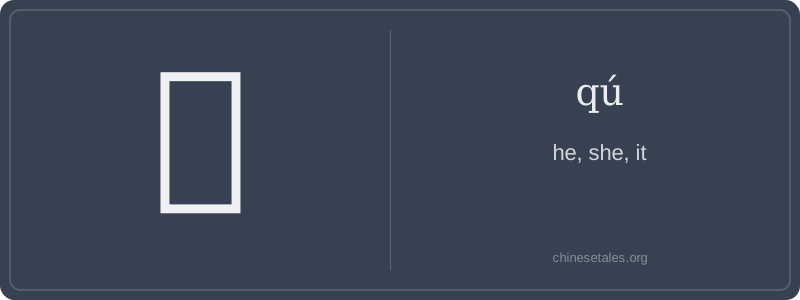
Here’s the twist: 佢 has no ancient oracle bone or bronze script origin—because it doesn’t exist in classical Chinese at all. It’s a late, vernacular creation: a phonetic-loan character (假借字) born in Southern Song or Ming dynasty colloquial texts, likely modeled after the shape of 也 (yě, ‘also’) or 他 (tā) but reshaped for Cantonese pronunciation. Its modern form—亻+巨—isn’t pictographic; it’s pragmatic: the radical 亻 (person) signals ‘person-related’, while 巨 (jù, ‘giant’) was borrowed purely for its sound (qú approximates older Yue pronunciation of *gɨ* or *kɨ*). No stroke evolution from ancient glyphs—just clever, grassroots orthographic hacking.
This character didn’t appear in the Kangxi Dictionary (1716) and wasn’t standardized until 20th-century Hong Kong publishing needed consistent ways to transcribe spoken Cantonese. You won’t find 佢 in the Analects or Tang poetry—it first surfaced in Cantonese opera scripts and early 1900s tabloids. Its visual simplicity (just two strokes beyond the radical!) mirrors its function: lean, efficient, and fiercely local. The ‘giant’ component isn’t about size—it’s a sonic anchor, preserving a vowel sound lost in Mandarin. So 佢 isn’t inherited; it’s invented—and proudly so.
Think of 佢 (qú) as Cantonese’s linguistic equivalent of a local dialect’s ‘y’all’—familiar, informal, and deeply regional. It means ‘he/she/it’, but unlike Mandarin’s gender-neutral 他 (tā), 佢 carries the warm, unselfconscious tone of spoken Cantonese—it’s the pronoun you’d hear in a Hong Kong dai pai dong while slurping wonton noodles, not in a Beijing news broadcast. It’s never written formally; you’ll see it only in subtitles, social media, or colloquial novels—not in textbooks or exams.
Grammatically, 佢 behaves like any subject pronoun: 佢係醫生 (qú haih yīsāang) = ‘He/She is a doctor.’ Note the verb ‘to be’ is 係 (haih), not shì—another giveaway this isn’t Mandarin. Learners often mistakenly try to use 佢 in Mandarin speech (‘Wǒ kànjiàn qú!’), which sounds instantly off—like ordering a bagel with kimchi in Brooklyn: technically edible, but culturally jarring. Also, 佢 has no plural form (no *佢哋 in basic usage here); for ‘they’, Cantonese uses 佢哋 (qú déi), but that’s a separate character combo.
Culturally, 佢 embodies linguistic identity: its absence from HSK and mainland textbooks reflects China’s official promotion of Putonghua—but in Hong Kong, Macau, and overseas Cantonese communities, 佢 is linguistic oxygen. A common mistake? Confusing it with Mandarin’s 他 (tā) in writing—resulting in sentences like ‘佢去了’ read aloud as *qú qù le*, which native Mandarin speakers won’t recognize. Remember: 佢 lives in sound, not standard script—it’s oral culture made visible.