票
Character Story & Explanation
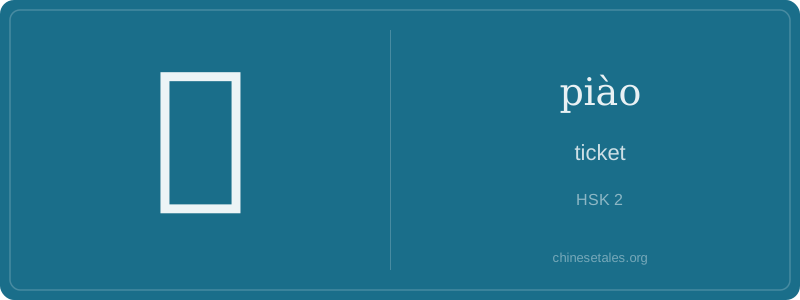
The earliest form of 票 appears in late Han dynasty clerical script — not oracle bone, but already richly symbolic. It combined 示 (shì), the 'altar' radical (originally a depiction of sacrificial stones), with 西 (xī, 'west'), which here served as a phonetic component. But look closer: the top part resembles a stylized banner or scroll unfurled over an altar — evoking a sacred decree or certified document. Over centuries, 西 simplified into the top ‘a’-shaped element (⺈ + 一 + 丨), while 示 remained anchored at the bottom, grounding the character in ritual authority.
This visual logic shaped its meaning: a 票 wasn’t just paper — it was a *certified token*, validated by an institution (state, temple, or later, railway bureau). In Ming and Qing novels, 票 appeared as tax receipts or travel permits issued by magistrates. By the 20th century, its scope exploded — from cinema tickets to stock certificates (股票 gǔpiào) — yet the core idea held: a small object carrying outsized institutional trust. Even today, scanning a QR code on your phone feels like a digital echo of that ancient altar-banner.
At its heart, 票 (piào) feels like a tiny, official slip of paper — crisp, authoritative, and slightly bureaucratic. It’s not just 'ticket' in the abstract; it’s the physical or digital token that grants you access: to a train, a concert, a vote, or even a lottery win. The character carries quiet weight — it implies legitimacy, eligibility, and sometimes scarcity ('only five tickets left!'). Notice how often it appears in compound nouns rather than standalone verbs: you don’t *'piào'* something — you *buy*, *show*, *lose*, or *check* a piào.
Grammatically, 票 is a countable noun, almost always used with measure words: 一张票 (yī zhāng piào) for most tickets, or 一注票 (yī zhù piào) specifically for lottery entries. Learners sometimes mistakenly use it like a verb ('I piào the bus'), but it never functions that way. Also, while English says 'bus ticket', Chinese often drops the word 'ticket' entirely: 坐地铁要买票 (zuò dìtiě yào mǎi piào) — literally 'taking the subway requires buying ticket' — where 票 alone suffices because context makes it obvious.
Culturally, 票 reflects China’s deep-rooted systems of verification and allocation: from imperial examination passes (科举考卷) to modern high-speed rail e-tickets scanned in under a second. A common mistake? Confusing it with 飘 (piāo, 'to float') — same sound but wildly different meaning and origin. Remember: 票 has the 'altar' radical 示 (shì), linking it to ritual authenticity, not air currents!