绍
Character Story & Explanation
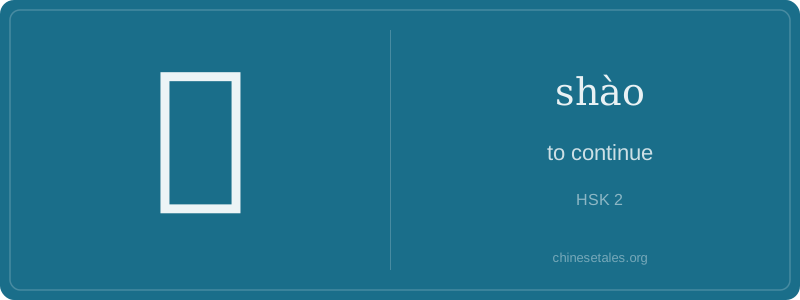
The earliest form of 绍 appears in Warring States bamboo slips — not as a pictograph, but as a phonosemantic compound already. Its left side 纟 (sī), the silk radical, hints at ancient ties: silk threads were symbols of continuity, unbroken lineage, and ritual binding. The right side 召 (zhào) was both sound clue and semantic anchor — originally a bronze script glyph showing a hand summoning someone under a roof, meaning 'to call forth'. Together, they formed a character that visually meant 'to call forth *in succession*', like summoning the next heir to assume duties — thread (纟) linking generations, voice (召) initiating the transfer.
By the Han dynasty, 绍 stabilized into its current eight-stroke form, shedding ornamental flourishes but keeping the elegant tension between thread and summons. In the Book of Rites, it appears in '绍宗庙之祀' — 'continue the ancestral temple sacrifices' — cementing its association with solemn, intergenerational duty. Even today, when you see the three silk strokes flowing leftward and the sharp, decisive 召 on the right, you’re seeing 2,300 years of cultural grammar: continuity isn’t automatic — it’s *called into being*.
Think of 绍 (shào) as the Chinese equivalent of a 'relay baton' — not the physical stick, but the *act* of passing it forward. Its core meaning, 'to continue', isn’t passive endurance but active succession: picking up where someone or something left off — a tradition, a story, a role, or even a family name. In English, we say 'carry on' or 'take over', but 绍 carries quiet reverence, like inheriting your grandfather’s calligraphy brush and using it to write the next generation’s wedding invitations.
Grammatically, 绍 almost never stands alone in modern speech. It’s the engine inside compound verbs: 介绍 (jièshào, 'to introduce') literally means 'to present + to continue' — i.e., to bridge two people by continuing connection; 继绍 (jìshào, 'to inherit and continue') doubles down on succession. Learners often mistakenly use 绍 alone ('I shào the project'), but it’s strictly bound — like 'er' in English: you say 'introduce', not just 'er'. You’ll always see it paired — usually with 介, 继, 或, or 承.
Culturally, 绍 whispers lineage. In classical texts, it appears in phrases like '绍先烈之志' ('continue the martyrs’ aspirations'), tying personal action to ancestral duty. A common pitfall? Confusing it with 少 (shǎo, 'few') — same sound, totally different world. Pronounce it sharply, like 'sh-ow' (not 'sh-ow-er'), and remember: if you’re *passing something on*, you need 绍 — not counting how few things you have.