给
Character Story & Explanation
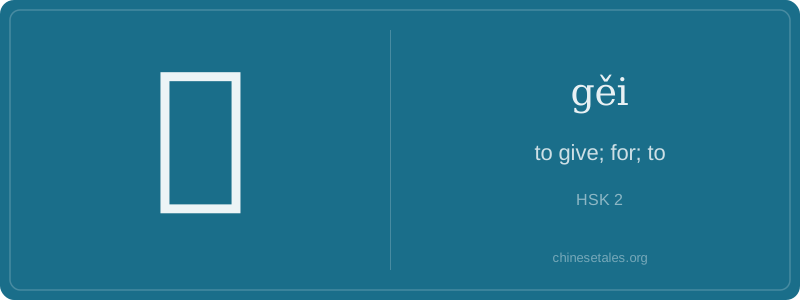
The earliest form of 给 appears in seal script as 給 — combining 纟 (sī, silk thread radical) on the left and 合 (hé, ‘to close/unite’) on the right. The silk thread hints at binding or connection; 合 originally depicted a lid fitting snugly onto a container — symbolizing completion, fitting, and mutual exchange. Over centuries, 合 simplified to 了 + 口, then further condensed into the modern 予 (yǔ) shape we see today — though crucially, it’s *not* the standalone character 予 (which means ‘to give’ but is literary and rare). The nine strokes evolved to balance elegance and clarity: three silky threads on the left, six precise strokes forming the right-hand component.
This visual logic mirrors its semantic journey: from concrete ‘binding together in exchange’ (Warring States texts used 給 for ‘providing supplies to troops’) to relational ‘giving to someone’. In the Classic of Filial Piety, 给 appears in contexts of children providing for aging parents — not as transaction, but as duty made tender. Even today, the silk radical whispers continuity: every act of giving strengthens the invisible thread between people. That’s why 给 feels less like handing over an object, and more like weaving a bond.
Imagine you’re at a Beijing street-side dumpling stall, and the vendor hands you a steaming basket — not just passing it over, but *giving it to you*, with clear intention and direction. That’s 给 (gěi) in action: it’s not just ‘give’ as a bare verb like 送 (sòng), but a grammatical workhorse that marks *who receives* something — whether physically (‘I give you money’) or abstractly (‘This book is for you’). It’s the glue in sentences like ‘wǒ gěi nǐ yī běn shū’ — where 给 pins down the recipient, making the sentence feel personal and purposeful.
Grammatically, 给 is indispensable in the ‘S + 给 + O + V’ structure (e.g., ‘tā gěi wǒ dǎ diàn huà’ — ‘He gives me a call’ = He calls me). Learners often mistakenly omit it and say ‘tā wǒ dǎ diàn huà’, which is ungrammatical — Chinese *requires* this directional marker. And yes, it’s pronounced jǐ in classical compounds like 自给自足 (zìjǐzìzú, ‘self-sufficient’), but for HSK 2, stick firmly with gěi — that’s your everyday, conversational voice.
Culturally, 给 carries quiet warmth: it implies care, responsibility, or even obligation — think of parents giving advice (gěi háizi jiàndào), or teachers giving homework (gěi zuòyè). A common mistake? Using 给 when you mean ‘to send’ (use 寄 jì) or ‘to hand over’ (use 交 jiāo). Remember: 给 isn’t about motion — it’s about *intended transfer to someone*. Miss it, and your sentence loses its human center.