课
Character Story & Explanation
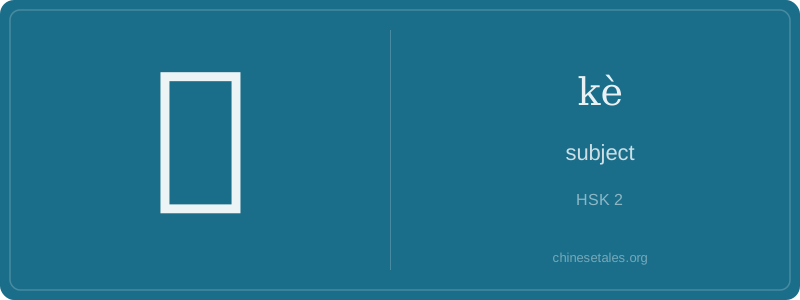
The earliest form of 课 appears in Han dynasty clerical script, not oracle bones — it’s a relatively late-comer among core characters. Visually, it fuses two parts: the left-side 讠 (yán bàng), the ‘speech’ radical, signaling communication and instruction; and the right-side 果 (guǒ), originally meaning ‘fruit’ or ‘result’, but here serving phonetically (guǒ → kè, sharing the ‘-uo’ vowel and falling tone shift). Over centuries, 果 simplified: its top ‘tree’ (木) became the horizontal stroke and dot, while the lower ‘field + mouth’ collapsed into the compact 口-like shape beneath — yielding today’s 10-stroke form: 讠+果 → 课.
This fusion tells a story: teaching is *speech that bears fruit*. By the Tang dynasty, 课 appeared in texts like the *Tang Code*, referring to tax quotas — literally ‘assessments’ or ‘measured obligations’. Only later did it pivot to education, reflecting how imperial civil service exams turned learning into a quantified, accountable process. Even now, 课 retains that subtle sense of evaluation: you don’t just ‘have’ a class — you *complete* it (kè wán), *review* it (fùxí kè), or *fail* it (bù jí gé). The character’s shape — speech + result — still whispers: ‘What did you harvest today?’
Imagine you’re in a Beijing middle school classroom, sunlight slanting across rows of desks. The bell rings — not for recess, but for kè: the 45-minute unit where knowledge is delivered, tested, and sometimes endured. That’s the heart of 课: it’s not just ‘subject’ like a textbook chapter — it’s a *scheduled intellectual event*, a measured slice of learning time with teachers, homework, and grades attached. You’ll hear it in ‘shùxué kè’ (math class), ‘kè biǎo’ (timetable), or ‘shàng kè’ (to attend class) — always tied to structure, routine, and pedagogy.
Grammatically, 课 is a noun that rarely stands alone; it almost always pairs with verbs like 上 (shàng, ‘to attend’), 下 (xià, ‘to dismiss’), or adjectives like 新 (xīn, ‘new’) or 难 (nán, ‘difficult’). Learners often mistakenly say ‘wǒ xué kè’ (I study class) — but no! You study *a subject* (e.g., yǔwén, Chinese language), not the class itself. Instead, you say ‘wǒ shàng kè’ (I attend class) or ‘wǒ zuò kè hòu zuòyè’ (I do homework after class). It’s a container word — the vessel for learning, not the content.
Culturally, 课 carries quiet weight: in China’s exam-driven system, each 课 represents a checkpoint on the path to academic success. Teachers are called ‘kè lǎoshī’, and even adult learners say ‘kāi xīn kē’ (launch a new course) — showing how deeply this character anchors formal education in daily life. A common slip? Using 课 for ‘lesson’ in the sense of a moral insight (that’s 教训 jiàoxùn) — 课 is institutional, not philosophical.