让
Character Story & Explanation
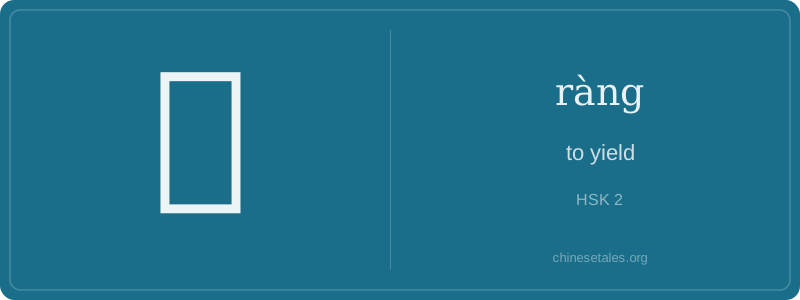
The earliest form of 让 appears in bronze inscriptions around 1000 BCE — not as a standalone character, but as part of the compound 讓 (with the radical 言 and the phonetic component 上). Its ancient shape combined ‘speech’ (言) and ‘ascending’ (上), hinting at the idea of ‘speaking upward’ — respectfully addressing elders or superiors. Over centuries, the left side simplified from full 言 to the modern speech radical 讠 (two strokes), while the right side evolved from 上 to 壬 (a stylized ‘person standing tall’), then finally to the current 尧-like form — all while preserving the core sense of deferential action initiated through language.
This visual journey mirrors its semantic evolution: from ritualized verbal submission in Zhou dynasty court ceremonies, to the philosophical ideal of selfless concession in Confucian ethics (Mencius praised ‘Yao yielding the throne to Shun’ as the highest moral act), and finally to everyday urban politeness. Interestingly, the character’s five-stroke simplicity belies its profound cultural load — it’s one of the few characters whose very shape embodies both humility (the small, humble 讠) and upright integrity (the tall, balanced right side).
Imagine you’re on a crowded Beijing subway at rush hour. A young man sees an elderly woman standing, hesitates for half a second — then stands up and gestures gently: ‘Nín zuò ba!’ (You sit!). That quiet, respectful gesture? That’s ràng. It’s not just ‘to give up’ — it’s yielding with warmth, humility, and social grace. In Chinese, 让 carries the soft weight of Confucian courtesy: it’s how you offer your seat, hand over the last dumpling, or defer to a teacher’s opinion — always with intention, never by accident.
Grammatically, 让 is wonderfully flexible. It can be a transitive verb (‘She let me go first’: 她让我先走), introduce causative constructions (‘The news made him cry’: 这个消息让他哭了), or appear in polite requests (‘Could you please step aside?’: 请您让一下). Learners often overuse it like English ‘let’, but note: 让 + verb implies permission *or* causing — context decides. Also, avoid saying ‘我让你’ without clear intent; alone, it can sound bossy or even threatening!
Culturally, 让 isn’t weakness — it’s strategic harmony. Ancient texts like the Book of Rites praise ‘ràng dé’ (the virtue of yielding) as foundational to civilized behavior. Modern speakers still use it to soften directives: ‘让开’ sounds firmer than ‘请让一下’. And watch out: in spoken Mandarin, ‘ràng’ is sometimes dropped in fast speech (e.g., ‘你先’ instead of ‘你先让’), but the yielding intent remains baked into the phrase.