卖
Character Story & Explanation
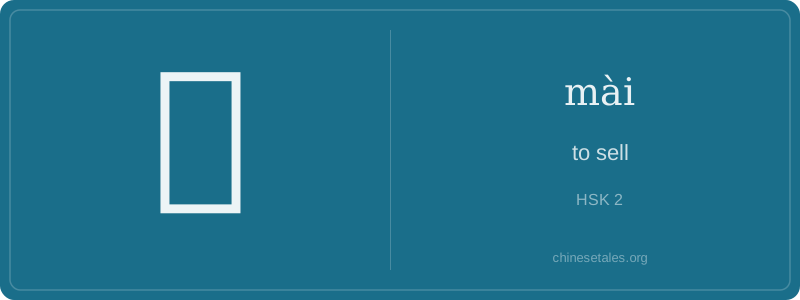
The earliest form of 卖 appears in bronze inscriptions as a combination of 売 (a variant of 出, meaning ‘to go out’) over 买 (mǎi, ‘to buy’), but by the Han dynasty, it simplified into today’s shape: top stroke (丿) + 十 (shí, ‘ten’, here acting as a phonetic anchor and structural frame) + 八 (bā, ‘eight’, suggesting ‘separation’ or ‘spreading apart’) + 一 (yī, ‘one’, grounding the base). The modern 8-stroke version crystallized during the regular script (kǎishū) era — every stroke serves dual roles: structure, sound hint, and semantic suggestion. That top-left 丿 looks like a raised hand offering goods; the 十 anchors the action firmly in the real world; the 八 subtly evokes items being handed over or dispersed.
This character evolved from concrete marketplace action to abstract social exchange. In the Classic of Filial Piety, 卖 is used to describe selling ancestral land — a grave moral act, underscoring its weightiness. By the Tang dynasty, poets like Bai Juyi used 卖 in poignant lines like ‘卖炭翁’ (mài tàn wēng — ‘the charcoal seller’), turning a simple verb into a symbol of labor, dignity, and hardship. Visually, the character’s balance — strong upper frame (十), open lower spread (八 + 一) — mirrors the moment of handing over goods: structured yet generous, controlled yet releasing.
At its core, 卖 (mài) isn’t just ‘to sell’ — it’s the active, intentional transfer of ownership for value. Think of a street vendor raising their voice, a hand gesture toward goods, or tapping a price tag: this character carries energy, agency, and transactional finality. Unlike passive verbs like 被 (bèi), 卖 always implies a willing seller and an exchange — you can’t ‘sell’ without something to offer and someone to receive it.
Grammatically, 卖 is a transitive verb that almost always takes a direct object (what’s being sold). You’ll say ‘卖水果’ (mài shuǐguǒ — sell fruit), never just ‘我卖’ alone in neutral contexts. It also frequently appears in serial verb constructions: ‘他去市场卖菜’ (tā qù shìchǎng mài cài — He goes to the market to sell vegetables), where 卖 explains the purpose of going. A common learner mistake? Using 卖 for ‘to be on sale’ — that’s actually 打折 (dǎzhé) or 促销 (cùxiāo); 卖 itself doesn’t mean ‘discounted’, only ‘to sell’.
Culturally, 卖 carries subtle connotations beyond commerce: 卖关子 (mài guānzi) means ‘to build suspense’ (literally ‘sell a checkpoint’ — like withholding info like a toll gate), and 卖弄 (màinòng) means ‘to show off’. These idioms reveal how deeply the idea of ‘offering something for attention or gain’ is embedded in the character — it’s not just about money, but about presentation, performance, and perceived value.